
DeFi Microfinance Latin America Financial Inclusion Sustainable
DeFi and Microfinance in Latin America: Opportunities for Sustainable Financial Inclusion
Financial exclusion remains a significant barrier to economic development and social equity across Latin America. Millions of individuals and small businesses lack access to basic financial services, hindering their ability to save, invest, and grow. This challenge, rooted in geographical remoteness, high transaction costs, and a lack of trust in traditional institutions, has long plagued the region. However, a new paradigm is emerging at the intersection of Decentralized Finance (DeFi) and microfinance, offering unprecedented opportunities to foster sustainable financial inclusion.
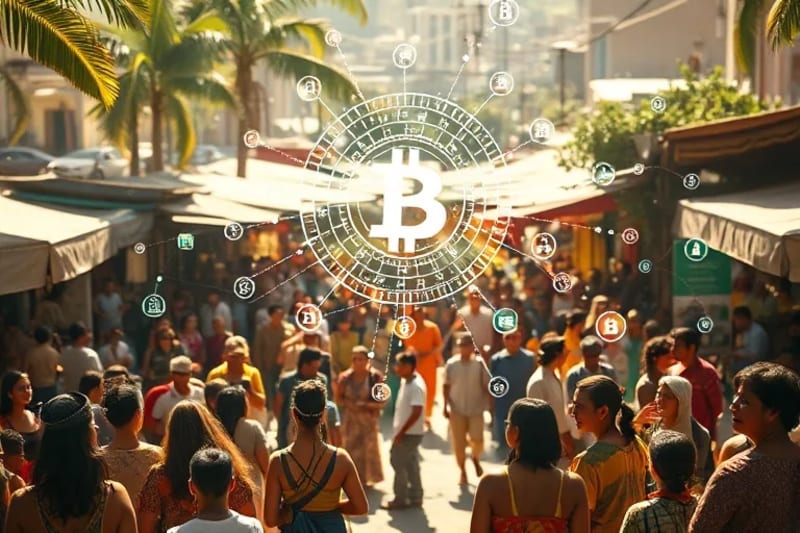
A vibrant depiction of a Latin American community engaging with advanced digital financial tools, symbolizing the fusion of traditional life with decentralized finance.
This article delves into how the innovative principles of DeFi can be strategically integrated with the established framework of microfinance to create robust, accessible, and transparent financial ecosystems. We will explore the current landscape of financial exclusion, the core tenets of DeFi, and the traditional role of microfinance, ultimately highlighting the synergistic potential that can unlock economic opportunities for underserved populations throughout Latin America. By leveraging blockchain technology, the region stands to redefine its financial future, moving towards a more equitable and prosperous society.
Table of Contents
- 1. The Imperative of Financial Inclusion in Latin America
- 2. Understanding Decentralized Finance (DeFi) and Its Pillars
- 3. Microfinance: Bridging the Gap, Past and Present
- 4. Synergies: How DeFi Elevates Microfinance
- 5. Transformative Opportunities for Latin America
- 6. Navigating the Challenges and Risks
- 7. The Future Landscape of Inclusive Finance
1. The Imperative of Financial Inclusion in Latin America
Latin America faces a persistent challenge with financial exclusion, where a substantial portion of its population remains unbanked or underbanked. This demographic often relies on informal financial channels, which are typically expensive, insecure, and lack the regulatory protections offered by formal institutions. The consequences are far-reaching, impacting individual livelihoods, small business growth, and overall economic stability.
According to recent reports, approximately 50% of adults in Latin America and the Caribbean do not have a bank account. This exclusion is particularly pronounced in rural areas, among indigenous communities, and for women. The lack of access to credit, savings accounts, and insurance products perpetuates cycles of poverty and limits upward mobility, making financial inclusion a critical development priority for the region.
The barriers to financial inclusion are multifaceted. They include geographical distance to financial institutions, stringent documentation requirements, high minimum balance thresholds, and a general distrust of traditional banks due to past financial crises or predatory practices. Furthermore, the prevalence of informal employment means many individuals lack the stable income proof often required for formal financial services. Addressing these systemic issues demands innovative solutions that can bypass traditional infrastructure and cater to the unique needs of these populations.
2. Understanding Decentralized Finance (DeFi) and Its Pillars
Decentralized Finance, or DeFi, refers to an ecosystem of financial applications built on blockchain technology, primarily Ethereum. Unlike traditional finance, DeFi operates without intermediaries like banks, brokers, or exchanges. Instead, it relies on smart contracts—self-executing agreements with the terms of the agreement directly written into code—to automate and secure financial transactions.
The core pillars of DeFi include transparency, immutability, and accessibility. Every transaction on a public blockchain is recorded and verifiable, fostering an unprecedented level of transparency. Once recorded, data cannot be altered, ensuring immutability. Crucially, DeFi platforms are accessible to anyone with an internet connection and a compatible digital wallet, removing the need for traditional bank accounts or extensive personal documentation. This open access is a game-changer for financially excluded populations.
Key components of the DeFi ecosystem include:
- Stablecoins: Cryptocurrencies pegged to stable assets like the US dollar, mitigating the volatility often associated with other digital currencies. This makes them suitable for savings and loans.
- Lending Protocols: Platforms that allow users to lend out their crypto assets to earn interest or borrow by providing collateral, all managed by smart contracts.
- Decentralized Exchanges (DEXs): Platforms for trading cryptocurrencies directly between users without a central authority, offering lower fees and greater control.
- Yield Farming: A method to earn rewards by staking or lending cryptocurrency assets, providing opportunities for passive income.
3. Microfinance: Bridging the Gap, Past and Present
Microfinance refers to a category of financial services targeted at individuals and small businesses who lack access to conventional banking and related services. It typically involves micro-loans, micro-savings, and micro-insurance. Historically, microfinance institutions (MFIs) have played a crucial role in poverty alleviation, particularly in developing economies, by providing small amounts of credit to entrepreneurs to start or expand businesses.
The traditional microfinance model, pioneered by figures like Muhammad Yunus and Grameen Bank, has achieved significant successes in empowering millions. It operates on principles of group lending, social collateral, and community-based support, which have proven effective in regions where formal collateral is scarce. These institutions often work closely with local communities, understanding their specific needs and cultural contexts.

A digital illustration highlighting the practical application of DeFi microfinance through a smartphone interface, empowering local communities.
Despite its successes, traditional microfinance faces several limitations. Operational costs for MFIs can be high due to the need for physical branches, staff, and manual processes for loan disbursement and collection. This often translates into higher interest rates for borrowers, which, while lower than informal lenders, can still be a burden. Scalability is another challenge, as expanding reach to remote areas requires significant investment in infrastructure. Furthermore, the reliance on centralized entities still introduces elements of trust and potential for corruption or inefficiency.
The evolution of economic models, including the rise of the Metaverse Digital Law: Property, Identity, Jurisdiction, suggests a shift towards more decentralized and peer-to-peer interactions. This trend aligns perfectly with the principles of DeFi, offering a potential path to overcome the inherent limitations of traditional microfinance and expand its impact significantly.
4. Synergies: How DeFi Elevates Microfinance
The convergence of DeFi and microfinance presents a powerful synergy that can address many of the challenges faced by traditional financial inclusion efforts. By integrating blockchain technology into microfinance operations, a new generation of services can emerge that are more efficient, transparent, and globally accessible.
One of the most significant advantages is the reduction of operational costs. DeFi protocols eliminate the need for costly intermediaries, physical branches, and extensive administrative overhead. Smart contracts automate loan origination, disbursement, and repayment tracking, drastically cutting down on manual processes and associated expenses. This efficiency can translate into lower interest rates for borrowers, making micro-loans more affordable and sustainable.
Increased transparency and trust are also paramount. Every transaction on a public blockchain is immutable and verifiable, providing a clear audit trail for all financial activities. This transparency can build greater trust among users, particularly in regions where faith in traditional financial institutions is low. Moreover, the immutability of records can help establish more reliable credit histories for individuals who previously operated outside formal systems.
DeFi's inherent wider reach and accessibility are transformative. Anyone with a smartphone and internet access can interact with DeFi protocols, regardless of their geographical location or banking status. This overcomes the physical barriers that often exclude rural populations from traditional financial services. The ability to access financial tools 24/7 from anywhere democratizes finance in an unprecedented way.
Furthermore, DeFi enables the creation of new and innovative financial products tailored for microfinance. These include:
- Decentralized Micro-loans: Peer-to-peer lending pools where individuals can borrow or lend stablecoins with transparent terms.
- Blockchain-based Savings: Stablecoin accounts that offer more stable value storage than volatile local currencies, often with opportunities to earn interest through DeFi protocols.
- Parametric Insurance: Automated insurance policies that pay out based on predefined conditions (e.g., crop failure due to specific weather events), removing the need for lengthy claims processes.
- Remittances: Faster and cheaper cross-border money transfers, directly benefiting families who rely on funds from relatives working abroad.
5. Transformative Opportunities for Latin America
Latin America stands at the cusp of a financial revolution, with DeFi and microfinance offering a unique pathway to widespread inclusion. The region's high mobile phone penetration, coupled with its historical challenges in traditional banking, makes it fertile ground for decentralized solutions. The opportunities are vast and can fundamentally alter the economic landscape for millions.

An abstract watercolor representing the organic growth and interconnectedness of sustainable digital finance across Latin America.
One of the most immediate impacts can be seen in remittances. Latin America is a major recipient of remittances, which often incur high fees and take days to process through traditional channels. DeFi-based solutions, utilizing stablecoins, can reduce costs significantly and enable near-instantaneous transfers, putting more money directly into the hands of families who need it most. This not only boosts household incomes but also stimulates local economies.
For small businesses and entrepreneurs, DeFi micro-loans can unlock critical access to capital. Many small business owners, like local grocers or artisans, struggle to secure loans from traditional banks due to a lack of collateral or formal credit history. DeFi platforms can leverage alternative data points or community-based lending models to assess creditworthiness, providing the necessary funds for expansion, inventory, or operational costs, thereby fostering economic growth at the grassroots level.
Moreover, DeFi offers avenues for savings and investments that are resilient to local currency volatility. By saving in stablecoins, individuals can protect their wealth from inflation and economic instability, a common concern in many Latin American countries. Yield farming and other DeFi investment opportunities, while requiring careful education, can also provide avenues for wealth creation that were previously inaccessible to the average citizen.
Finally, the very nature of interacting with DeFi tools promotes financial education and literacy. Users are encouraged to understand the underlying technology, manage their digital assets, and make informed financial decisions. This empowerment, combined with initiatives focused on future education and digital skills, can create a more financially savvy population capable of navigating the complexities of the modern economy.
6. Navigating the Challenges and Risks
While the potential of DeFi in Latin American microfinance is immense, it is not without its challenges and risks. Addressing these proactively is crucial for ensuring the sustainable and equitable adoption of these technologies. A balanced approach that fosters innovation while safeguarding users is essential for long-term success.
One of the primary hurdles is regulatory uncertainty. Many Latin American countries are still developing comprehensive legal frameworks for cryptocurrencies and DeFi. The absence of clear regulations can deter institutional adoption, create legal ambiguities for users, and potentially expose them to unregulated markets. Governments and international bodies must collaborate to establish clear, protective, and innovation-friendly regulatory environments, drawing lessons from existing commercial codes, such as the , but adapted for the digital age.
Technological literacy and the digital divide also pose significant challenges. While smartphone penetration is high, a substantial portion of the population, particularly in rural areas, may lack the digital skills necessary to navigate complex DeFi interfaces. Educational initiatives are vital to bridge this gap, ensuring that the benefits of DeFi are accessible to everyone, not just the tech-savvy few. User-friendly interfaces and simplified onboarding processes will be critical for mass adoption.
The volatility of cryptocurrencies, though mitigated by stablecoins, remains a concern. While stablecoins are designed to maintain a consistent value, they are not entirely risk-free and can be subject to market fluctuations or regulatory actions. Educating users about these risks and promoting the use of well-audited stablecoins are important steps. Furthermore, security risks, such as smart contract vulnerabilities, phishing scams, and hacks, are inherent in any nascent technological ecosystem. Robust security audits, user education on best practices, and decentralized insurance protocols can help mitigate these threats.
Finally, infrastructure limitations, including inconsistent internet access and unreliable electricity in remote areas, can impede the widespread adoption of DeFi. Investments in digital infrastructure are necessary to ensure that these technologies can truly reach the last mile. Overcoming these challenges requires a concerted effort from governments, technology providers, non-governmental organizations, and local communities.
7. The Future Landscape of Inclusive Finance
The integration of DeFi and microfinance holds the promise of fundamentally reshaping the financial landscape of Latin America, ushering in an era of unprecedented financial inclusion. As these technologies mature and become more user-friendly, their potential to empower underserved populations will only grow. The future of inclusive finance in the region is likely to be a hybrid model, combining the best aspects of traditional microfinance with the innovation and efficiency of decentralized systems.
Key recommendations for fostering this future include:
- Collaborative Ecosystems: Encouraging partnerships between traditional microfinance institutions, blockchain developers, local governments, and NGOs to co-create solutions tailored to specific community needs.
- Education and Capacity Building: Investing heavily in financial literacy and digital skills training programs, making them accessible in local languages and through diverse channels.
- Regulatory Sandboxes: Establishing controlled environments where innovative DeFi microfinance solutions can be tested and refined under regulatory supervision, allowing for learning and adaptation.
- Focus on User Experience: Prioritizing intuitive and simple interfaces that abstract away the technical complexities of blockchain, making DeFi accessible to non-technical users.
- Development of Local Stablecoins: Exploring the creation of stablecoins pegged to local fiat currencies to reduce foreign exchange risk and increase relevance for domestic transactions.
Source: Hybrid content assisted by AI and human editorial supervision.


Comentarios