
Floating Cities: Sustainable Aquatic Architecture Future
Sustainable Aquatic Architecture: The Future of Floating Cities in the Face of Climate Change
As global climate change accelerates, presenting unprecedented challenges such as rising sea levels and increased frequency of extreme weather events, humanity is compelled to rethink its relationship with the environment and traditional urban planning. Coastal communities worldwide face the imminent threat of displacement and destruction, necessitating innovative and resilient solutions. Among the most visionary and promising concepts emerging from this global crisis is sustainable aquatic architecture, particularly the development of floating cities. These structures represent not just an architectural marvel but a paradigm shift towards harmonious coexistence with water, offering a potential blueprint for future urban development.
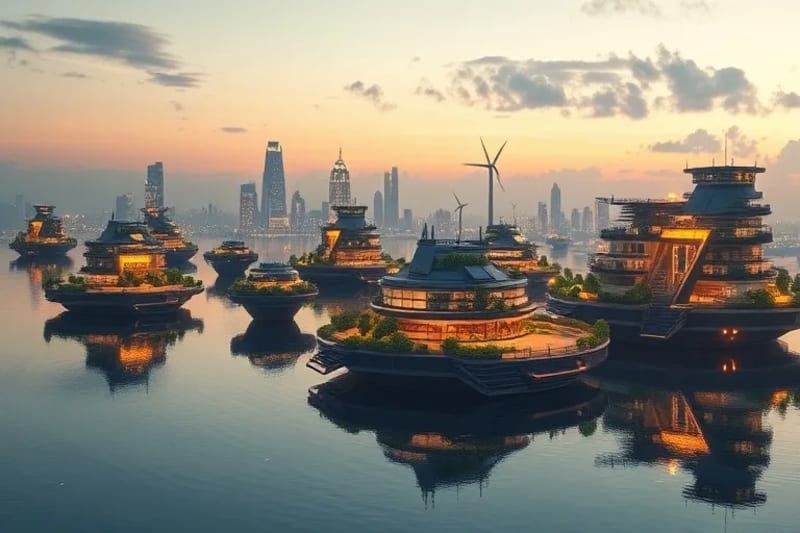
A visionary depiction of a sustainable floating city, showcasing integrated renewable energy and lush vertical gardens, offering a glimpse into future urban resilience.
Floating cities are no longer confined to the realm of science fiction. They are becoming a tangible reality, driven by necessity and technological advancements. This article delves into the principles, challenges, and immense potential of sustainable aquatic architecture, exploring how these innovative urban centers can provide a viable pathway for human civilization to adapt and thrive in a changing world.
The concept of living on water has historical roots, from traditional stilt houses to modern houseboats. However, contemporary aquatic architecture takes this idea to an entirely new level, envisioning self-sufficient, eco-friendly communities designed to float permanently on the ocean or large bodies of water. These structures are engineered to be resilient against environmental shifts, providing stable and sustainable habitats for growing populations.
Table of Contents
- The Urgency: Climate Change and Coastal Vulnerability
- The Genesis of Floating Cities: From Concept to Reality
- Pillars of Sustainable Aquatic Architecture
- Technological Innovations Driving Floating Urbanism
- Challenges and Socio-Economic Considerations
- Real-World Projects and Future Prospects
- Conclusion: Charting a Course for a Resilient Future
The Urgency: Climate Change and Coastal Vulnerability
The scientific consensus on climate change is unequivocal. Global temperatures are rising, leading to a cascade of environmental impacts that disproportionately affect coastal regions. The primary concern is sea-level rise, driven by thermal expansion of ocean water and the melting of glaciers and ice sheets. According to the Intergovernmental Panel on Climate Change (IPCC), global mean sea level is projected to rise by several decimeters to over a meter by 2100, depending on emission scenarios.
This rise threatens millions of people living in low-lying coastal areas, megacities, and small island nations. The consequences extend beyond mere inundation:
- Increased Flooding: Higher sea levels mean more frequent and severe coastal flooding, even during normal tides.
- Coastal Erosion: Shorelines recede, destroying natural habitats, infrastructure, and agricultural land.
- Saltwater Intrusion: Freshwater sources become contaminated with salt, impacting drinking water supply and agriculture.
- Extreme Weather Events: Climate change intensifies hurricanes, typhoons, and storm surges, making coastal areas even more vulnerable.
- Displacement and Migration: Entire communities may be forced to relocate, leading to social and economic disruption.
Traditional land-based defenses, such as seawalls and dikes, are often costly, environmentally disruptive, and may only offer temporary solutions. This pressing need for adaptable and resilient infrastructure has propelled aquatic architecture to the forefront of urban planning discussions.
The Genesis of Floating Cities: From Concept to Reality
The idea of floating structures is not new. Historically, communities have adapted to water environments through various means, from ancient lake dwellings to modern-day houseboats and floating markets. However, the modern concept of a "floating city" as a self-sustaining, permanent settlement designed to address contemporary environmental challenges began to gain traction in the late 20th and early 21st centuries.
Early proponents, like the Seasteading Institute, championed the idea of creating new societies on the open ocean, free from existing governmental regulations. While this vision was largely libertarian, it laid some groundwork for the engineering and logistical considerations of large-scale floating habitats. More recently, the focus has shifted towards creating resilient coastal extensions or entirely new cities in protected waters, often in collaboration with existing nations and international bodies.
The fundamental principle behind floating cities is resilience. Unlike land-based structures that are static and vulnerable to rising water levels, floating cities are inherently adaptable. They can rise and fall with the tides and sea levels, mitigating the risk of flooding. This dynamic interaction with water offers a sustainable alternative to continuously building higher defenses or abandoning coastal areas entirely.
Pillars of Sustainable Aquatic Architecture
Sustainable aquatic architecture is built upon several core principles that ensure ecological harmony, resource efficiency, and long-term viability. These pillars guide the design, construction, and operation of floating cities, aiming for a minimal environmental footprint and maximum self-sufficiency.
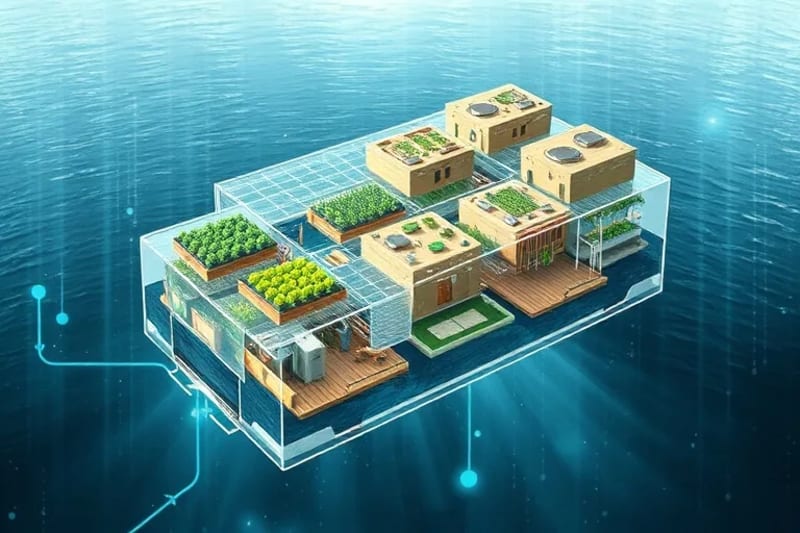
An intricate watercolor design illustrating the internal systems of an eco-friendly floating module, highlighting circular economy principles.
- Sustainable Materials: The choice of materials is crucial. Architects and engineers prioritize materials that are buoyant, durable, non-toxic, and have a low environmental impact. This includes recycled plastics, bamboo, engineered wood, and advanced lightweight concrete. The goal is to minimize the carbon footprint associated with construction and ensure materials can be recycled or repurposed at the end of the structure's life.
- Renewable Energy Systems: Self-sufficiency in energy is a hallmark of sustainable aquatic architecture. Floating cities are designed to harness abundant renewable resources. Solar panels integrated into roofs and facades, wind turbines, and even tidal or wave energy converters are essential components. Energy storage solutions, such as advanced battery systems, ensure a continuous power supply.
- Advanced Water Management: Freshwater scarcity is a global issue, and floating cities must address it proactively. Technologies like desalination using reverse osmosis, efficient rainwater harvesting, and advanced wastewater treatment systems are critical. Treated wastewater can be recycled for non-potable uses, creating a closed-loop system that minimizes waste and conserves resources.
- Integrated Food Production: To reduce reliance on external supply chains and enhance food security, floating cities often incorporate innovative food production methods. Vertical farms, hydroponics, and aquaponics systems can be integrated into residential and communal spaces, producing fresh fruits, vegetables, and fish with minimal land (or water) footprint.
- Waste-to-Resource Systems: Embracing circular economy principles, floating cities aim for zero waste. Advanced waste management systems convert waste into energy or valuable resources. This includes composting organic waste, recycling inorganic materials, and potentially utilizing waste-to-energy technologies where appropriate.
- Ecosystem Integration and Biodiversity: A truly sustainable aquatic structure does not merely float on water but integrates with and enhances the marine ecosystem. This involves designing foundations that can serve as artificial reefs, fostering marine biodiversity. Careful consideration is given to water circulation, light penetration, and the use of non-toxic materials to protect aquatic life.
Technological Innovations Driving Floating Urbanism
The realization of floating cities relies heavily on cutting-edge technological advancements across various fields. These innovations make it possible to design, construct, and maintain complex, resilient, and comfortable habitats on water.
- Modular Design and Construction: Floating cities are often conceived as modular structures. Individual platforms or buildings are prefabricated on land and then towed to the site for assembly. This approach allows for scalability, flexibility, and easier maintenance or expansion. Modules can be specialized for different functions—residential, commercial, green spaces, or infrastructure—and interconnected to form larger communities.
- Advanced Buoyancy Systems: The stability and longevity of floating structures depend on sophisticated buoyancy systems. These can range from hollow concrete caissons and steel pontoons to innovative materials like expanded polystyrene (EPS) foam encased in concrete. Engineers use advanced hydrodynamics modeling to ensure stability against waves, currents, and wind.
- Smart City Integration: Floating cities are ideal candidates for smart city technologies. Integrated sensor networks can monitor environmental conditions (water quality, air quality, energy consumption), manage waste, optimize resource distribution, and enhance public safety. AI-driven systems can predict maintenance needs and manage energy grids efficiently.
- Dynamic Anchoring and Mooring: To keep floating structures in place while allowing for vertical movement, dynamic anchoring and mooring systems are employed. These can include flexible cables, tension leg platforms, or dynamic positioning systems that use thrusters to maintain position, particularly in deeper or more exposed waters.
- Biomimicry in Design: Drawing inspiration from nature, biomimicry plays a significant role. Designs may emulate the structural efficiency of coral reefs, the wave-dampening properties of mangrove roots, or the self-cleaning mechanisms of certain aquatic plants. This approach not only enhances resilience but also promotes ecological integration.
Challenges and Socio-Economic Considerations
Despite their immense potential, floating cities face significant challenges that must be addressed for their widespread adoption. These include technical, economic, regulatory, and social hurdles.
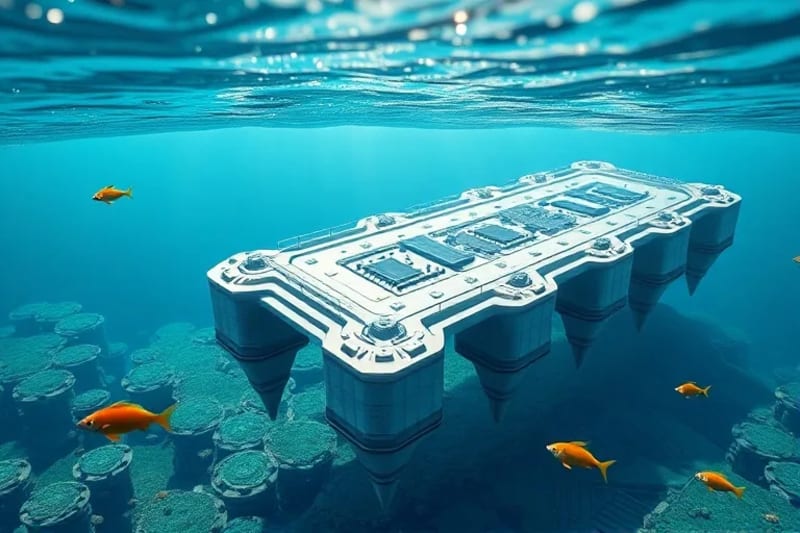
A detailed 3D render showcasing the resilient underwater foundations of a floating city, designed to integrate with marine ecosystems.
- High Initial Costs: The research, development, and construction of floating cities are currently very expensive. Advanced materials, complex engineering, and specialized construction techniques contribute to high upfront investment. However, as technology matures and economies of scale are achieved, costs are expected to decrease.
- Regulatory and Legal Frameworks: Existing international and national laws are not typically designed for permanent settlements on water. Issues of sovereignty, jurisdiction, property rights, and environmental regulations need to be developed and agreed upon. This requires significant diplomatic and legal innovation.
- Social Acceptance and Lifestyle Adaptation: Living on a floating structure presents a unique lifestyle that may not appeal to everyone. Concerns about motion sickness, isolation, access to services, and a sense of permanence can affect social acceptance. Community engagement and careful urban planning are essential to create desirable and inclusive environments.
- Environmental Impact During Construction: While the long-term goal is ecological harmony, the construction phase can have temporary environmental impacts, such as disruption of marine habitats or increased carbon emissions. Mitigating these impacts through careful planning and sustainable construction practices is crucial.
- Infrastructure Connectivity: Connecting floating cities to existing land-based infrastructure (power grids, internet, transportation) can be complex and costly. Developing self-sufficient systems for energy, water, and waste is paramount to reduce this dependency.
Addressing these challenges requires a multidisciplinary approach, involving engineers, architects, urban planners, environmental scientists, economists, and policymakers. International cooperation will be vital for developing universal standards and facilitating cross-border projects.
Real-World Projects and Future Prospects
Several ambitious projects around the world are pushing the boundaries of aquatic architecture, demonstrating the feasibility and potential of floating cities. These initiatives serve as crucial testbeds for technologies and concepts.
- OCEANIX Busan, South Korea: One of the most prominent projects is OCEANIX Busan, a prototype floating city developed in partnership with UN-Habitat and the city of Busan. Designed by BIG-Bjarke Ingels Group, it envisions a modular, flood-proof community that produces its own food, water, and energy. The platforms are designed to be resilient to category 5 hurricanes and rise with the sea level.
- The Floating City Project (Maldives): The Maldives, a nation highly vulnerable to sea-level rise, is actively exploring floating city solutions. The Maldives Floating City, a collaboration with Dutch Docklands, aims to create a network of floating islands with homes, hotels, and businesses, designed to move with the currents and provide a sustainable future for its inhabitants.
- Dutch Innovations: The Netherlands, with its extensive experience in water management, is a leader in floating architecture. Projects like the Floating Pavilion in Rotterdam and various floating homes demonstrate practical applications of buoyant construction, offering valuable insights for larger-scale developments.
- Seasteading Institute's Concepts: While often controversial for its libertarian ideals, the Seasteading Institute continues to explore designs for autonomous floating communities, contributing to the engineering discourse on offshore living.
The future prospects for sustainable aquatic architecture are increasingly optimistic. As climate change impacts intensify, the necessity for such solutions will only grow. These cities offer not only a refuge from rising waters but also an opportunity to build truly sustainable, self-sufficient, and innovative communities that integrate human habitation with marine ecosystems. They represent a bold vision for a future where humanity lives in harmony with the planet's most abundant resource: water.
Conclusion: Charting a Course for a Resilient Future
Sustainable aquatic architecture and the concept of floating cities are more than just architectural novelties; they are a profound response to one of humanity's most pressing challenges. By embracing innovative design, advanced engineering, and a deep commitment to environmental stewardship, these floating communities offer a viable path forward for coastal populations facing the brunt of climate change.
While significant hurdles remain, particularly in terms of cost, regulation, and social integration, the ongoing development of pioneering projects demonstrates that the vision is attainable. As our understanding of marine environments deepens and technology continues to evolve, floating cities could become integral components of a resilient global infrastructure, fostering new economies, cultures, and a renewed respect for our planet's aquatic realms. The future of urban living may very well be afloat, navigating the challenges of a changing climate with ingenuity and sustainability at its core.
Fuente: Contenido híbrido asistido por IAs y supervisión editorial humana.


Comentarios