
Rosalind Franklin Viral Structure Contributions Beyond DNA
The name Rosalind Franklin is predominantly associated with the discovery of the DNA double helix, a monumental achievement in molecular biology. Her meticulous X-ray diffraction images, particularly "Photo 51," were instrumental in Watson and Crick's elucidation of DNA's structure. However, reducing her legacy solely to DNA overlooks a substantial and equally pioneering body of work: her critical contributions to understanding the intricate structures of viruses. This article delves into the often-ignored chapters of her career, highlighting how her expertise in X-ray crystallography unlocked the secrets of viral architecture, laying foundational knowledge for virology and vaccine development.

The unwavering gaze of a brilliant scientist whose work redefined our understanding of life's fundamental structures.
Table of Contents
- Early Life and Scientific Foundation
- Mastering X-ray Crystallography
- The Tobacco Mosaic Virus (TMV) Breakthrough
- Expanding Horizons: Other Viral Structures
- Methodology and Scientific Rigor
- Impact on Virology and Vaccine Development
- Legacy Beyond the Double Helix
- Modern Relevance and Recognition
Rosalind Elsie Franklin (1920-1958) was a British biophysicist and X-ray crystallographer whose work was fundamental to the understanding of the molecular structures of DNA, RNA, viruses, coal, and graphite. Born into an affluent British Jewish family, Franklin displayed exceptional academic prowess from an early age, particularly in science. Her education at St Paul's Girls' School and later at Newnham College, Cambridge, solidified her passion for physical chemistry and laid the groundwork for her future groundbreaking research.
Early Life and Scientific Foundation
Franklin's academic journey was marked by a relentless pursuit of knowledge and a rigorous scientific approach. After graduating from Cambridge in 1941, she worked for the British Coal Utilisation Research Association, where her research on the porosity of coal provided the basis for her PhD thesis, which she earned from Cambridge University in 1945. This early work honed her skills in experimental design and data interpretation, particularly with X-ray diffraction techniques, which would become her signature methodology.
Her subsequent move to Paris in 1947, where she worked at the Laboratoire Central des Services Chimiques de l'État, proved pivotal. Under the tutelage of Jacques Mering, she became an expert in X-ray crystallography, a technique used to determine the atomic and molecular structure of a crystal. This method involves diffracting X-rays through a crystal and then collecting the diffraction patterns, which can be mathematically analyzed to reconstruct the three-dimensional structure of the molecules within the crystal. This period in Paris was crucial for developing the advanced skills she would later apply to biological molecules.
Mastering X-ray Crystallography
X-ray crystallography is a powerful technique that relies on the diffraction of X-rays by the atoms in a crystal. When X-rays encounter a crystal, they are scattered by the electrons of the atoms. These scattered waves then interfere with each other, producing a characteristic diffraction pattern. By analyzing the angles and intensities of these diffracted X-rays, scientists can deduce the electron density within the crystal, which in turn reveals the positions of the atoms and thus the molecular structure.
Franklin's mastery of this technique was exceptional. She understood the critical importance of sample preparation, precise experimental conditions, and meticulous data analysis. Her ability to produce high-quality X-ray diffraction images, coupled with her rigorous interpretation, set her apart. This expertise was not only evident in her DNA work but became even more pronounced and independently recognized in her subsequent research on viruses.

The essential tools of a mid-20th-century biophysicist, symbolizing the precision required for groundbreaking molecular research.
The Tobacco Mosaic Virus (TMV) Breakthrough
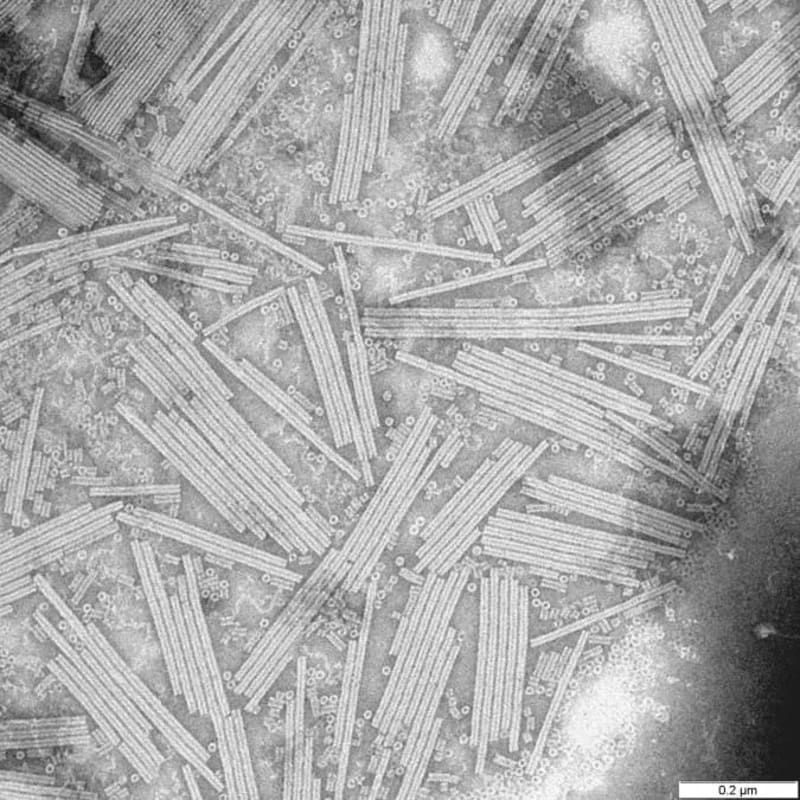
After her challenging tenure at King's College London, Franklin moved to Birkbeck College in 1953, where she led her own research group. It was here that she shifted her focus to the study of viruses, particularly the Tobacco Mosaic Virus (TMV). TMV was one of the first viruses to be discovered and extensively studied, known for infecting a wide range of plants, especially tobacco. Its relatively simple structure made it an ideal candidate for X-ray diffraction studies.
Franklin and her team, notably Aaron Klug (who would later win a Nobel Prize for his work on viral structures, acknowledging Franklin's foundational contributions), applied her refined X-ray crystallography techniques to TMV. Their work revealed that TMV was a hollow cylinder, approximately 300 Ångströms long and 180 Ångströms in diameter, with its genetic material (RNA) coiled in a helical groove within the protein coat. This was a revolutionary discovery, providing the first detailed structural model of a virus.
Key findings from their TMV research included:
- Helical Structure: Franklin definitively showed that the protein subunits of TMV were arranged in a helix around the central RNA core.
- RNA Location: She determined that the RNA was not inside the protein, but embedded within the protein helix itself, a crucial insight for understanding viral replication.
- Protein Subunits: Her work helped to elucidate the arrangement and number of protein subunits that make up the viral capsid.
This detailed structural information was critical for understanding how viruses assemble, replicate, and infect host cells. It provided a blueprint for future studies on other viruses and laid the groundwork for rational drug design and vaccine development strategies.
Expanding Horizons: Other Viral Structures
Franklin's work at Birkbeck was not limited to TMV. She and her team extended their X-ray diffraction studies to other plant viruses, including the turnip yellow mosaic virus (TYMV) and the potato virus X (PVX). Her research on TYMV, for instance, helped to establish the concept of icosahedral symmetry in viruses, which is a common structural motif in many spherical viruses.
The discovery of icosahedral symmetry was another significant contribution. Many viruses, particularly those with spherical shapes, exhibit this highly efficient and stable geometric arrangement. Franklin's work provided early evidence for this, which was later confirmed and expanded upon by others. This understanding of viral symmetry is crucial for comprehending how viruses package their genetic material and interact with host cells.
Her meticulous approach allowed for comparative studies, revealing both commonalities and differences in viral architecture. This comparative virology was essential for developing a broader understanding of viral evolution and classification. Her work demonstrated that while viruses are diverse, they often adhere to fundamental structural principles, which can be deciphered through techniques like X-ray crystallography.
Methodology and Scientific Rigor
Franklin's scientific methodology was characterized by an unwavering commitment to precision and empirical evidence. She was known for her rigorous experimental design, careful sample preparation, and thorough data analysis. This approach ensured the high quality and reliability of her X-ray diffraction patterns, which were often superior to those produced by her contemporaries.
Her work on TMV, for example, involved:
- High-Resolution Images: Producing exceptionally clear X-ray diffraction photographs that allowed for detailed structural analysis.
- Quantitative Analysis: Applying complex mathematical calculations to interpret the diffraction patterns, moving beyond qualitative observations.
- Controlling Hydration: Recognizing and controlling the hydration levels of her samples, a critical factor that significantly influenced the quality of diffraction patterns for biological molecules.
This methodical rigor was a hallmark of her scientific contributions and ensured that her findings were robust and reproducible. Her insistence on empirical data and cautious interpretation contrasted with some of her peers, but ultimately led to more accurate and reliable scientific conclusions.
A conceptual visualization of the complex and beautiful structures of viruses, illuminated by the light of scientific understanding.
Impact on Virology and Vaccine Development
Franklin's structural work on viruses had profound and lasting implications for virology and medicine. By providing the first detailed blueprints of viral architecture, she enabled scientists to understand:
- Viral Assembly: How protein subunits self-assemble to form the protective capsid around the genetic material.
- Host Interaction: How the surface features of a virus might interact with host cell receptors during infection.
- Antiviral Strategies: The potential targets for antiviral drugs that could disrupt viral structure or assembly.
Her research was foundational for the development of modern virology. Understanding the precise arrangement of proteins and genetic material within a virus is a prerequisite for designing effective vaccines. For example, many vaccines work by presenting viral proteins to the immune system. Knowing the exact structure of these proteins, as revealed by X-ray crystallography, allows for the design of more potent and specific immunogens.
The principles she established for TMV and other plant viruses were later applied to human and animal viruses, contributing to the broader understanding of viral pathogenesis and immunity. Her work indirectly supported the development of vaccines for diseases like polio, influenza, and hepatitis, by providing the fundamental structural insights necessary for their study.
Legacy Beyond the Double Helix
While the DNA story often overshadows her other achievements, Franklin's viral research represents a significant and independent contribution to science. Her work at Birkbeck was conducted with her own team, under her own leadership, and resulted in numerous publications in prestigious journals like Nature. This body of work solidified her reputation as a leading X-ray crystallographer and a pioneer in structural biology.
It is crucial to recognize that her contributions to virology were not merely an extension of her DNA work but a distinct and equally impactful phase of her career. She applied the same meticulousness and intellectual rigor to unraveling viral structures, demonstrating her versatility and deep understanding of molecular architecture. Her insights into the helical and icosahedral symmetries of viruses were groundbreaking and continue to be fundamental concepts in virology.
Tragically, Rosalind Franklin's life was cut short by ovarian cancer at the age of 37, likely due to her extensive exposure to X-rays during her research. She passed away in 1958, four years before Watson, Crick, and Wilkins received the Nobel Prize for their work on DNA. The Nobel Prize is not awarded posthumously, which meant her pivotal role in the DNA discovery could not be formally recognized by the committee.
Modern Relevance and Recognition
Today, Rosalind Franklin's contributions are increasingly recognized, not just for DNA but for her broader impact on structural biology. Her work on viruses continues to be relevant in an era dominated by viral outbreaks and the urgent need for new antiviral therapies and vaccines. The fundamental principles she established for understanding viral structure remain cornerstones of modern virology.
Institutions worldwide now bear her name, and numerous awards celebrate her legacy. Her story serves as a powerful reminder of the often-overlooked contributions of women in science and the importance of recognizing the full breadth of a scientist's work. Her dedication to empirical evidence, her technical prowess, and her unwavering scientific integrity continue to inspire new generations of researchers.
The scientific community has made significant strides in acknowledging her rightful place in history. The Rosalind Franklin University of Medicine and Science in Chicago, and the Rosalind Franklin Award and Lecture by the Royal Society, are just a few examples of how her profound impact is now celebrated. Her work on viral structures, though less publicized than her DNA research, is a testament to her extraordinary scientific vision and enduring legacy.
In conclusion, Rosalind Franklin was far more than "the dark lady of DNA." Her meticulous and groundbreaking work on viral structures, particularly the Tobacco Mosaic Virus, provided essential insights into how viruses are built and how they function. This body of research was critical for the nascent field of virology and continues to inform our understanding of viral diseases and the development of countermeasures. Her scientific journey exemplifies the power of rigorous methodology and the profound impact a single dedicated researcher can have across multiple scientific frontiers.
Fuente: Contenido híbrido asistido por IAs y supervisión editorial humana.


Comentarios