
Donna Haraway: Cyborg Manifesto, Posthumanism, Future Identities
Donna Haraway: Cyborg Manifesto, Posthumanism, and Future Identities
Donna Haraway, a distinguished scholar in the fields of science and technology studies, feminist theory, and posthumanism, has profoundly influenced contemporary thought with her radical ideas on the interconnectedness of biology, technology, and society. Her work challenges conventional boundaries, urging us to reconsider what it means to be human in an increasingly technologically mediated world. Haraway's seminal "A Cyborg Manifesto" (1985) introduced the concept of the cyborg not merely as a fictional entity but as a potent metaphor for understanding modern identities and political possibilities.
- 1. The Cyborg Manifesto: Deconstructing Boundaries
- 2. Posthumanism and the Critique of Anthropocentrism
- 3. Situated Knowledges and the Illusion of Objectivity
- 4. Companion Species and Interspecies Ethics
- 5. The Chthulucene and Staying with the Trouble
- 6. Haraway's Legacy and the Shaping of Future Identities
Her work extends beyond the theoretical, offering practical frameworks for ethical engagement with scientific advancements and ecological crises. Haraway challenges us to embrace complex, hybrid identities and to forge new forms of solidarity that transcend traditional categories of gender, race, species, and machine. By exploring her key concepts, we can gain a deeper understanding of the intricate tapestry of our existence and the potential pathways for a more just and sustainable future.
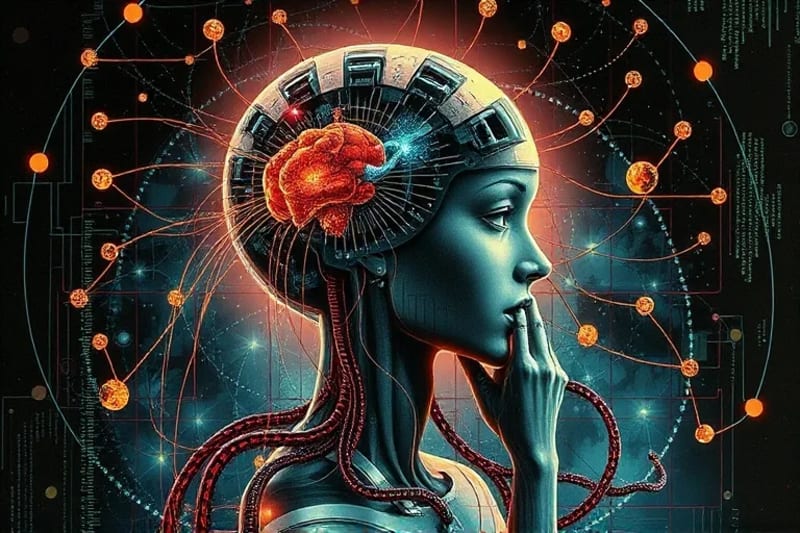
A scholar's workspace, reflecting the depth of research and theoretical development that underpins critical social thought.
1. The Cyborg Manifesto: Deconstructing Boundaries
Published in 1985, "A Cyborg Manifesto: Science, Technology, and Socialist-Feminism in the Late Twentieth Century" is perhaps Haraway's most iconic contribution. In this essay, she proposes the figure of the cyborg—a cybernetic organism, a hybrid of machine and organism—as a powerful tool for dismantling dualisms that have historically structured Western thought. These dualisms include mind/body, human/animal, organism/machine, male/female, and nature/culture.
The cyborg, for Haraway, is a creature of a post-gender world, challenging essentialist notions of identity and advocating for a politics of affinity rather than identity. It represents a rejection of utopian and dystopian narratives about technology, instead embracing the messy, contradictory reality of technological integration into daily life. This perspective encourages us to recognize how technology shapes our bodies, our thoughts, and our social interactions, blurring the lines between what is "natural" and what is "artificial."
Haraway argues that the cyborg offers a way to move beyond oppressive categories and to build new political formations. It is a figure that thrives on partiality, irony, and intimacy, refusing grand narratives of origin or destiny. This embrace of hybridity allows for a more nuanced understanding of power dynamics and opens avenues for collective action rooted in shared experiences of technological mediation and biological plasticity.
2. Posthumanism and the Critique of Anthropocentrism
Haraway's work is central to posthumanist thought, which seeks to move beyond the traditional humanist emphasis on the human as the sole measure of value and meaning. Posthumanism, as she articulates it, is not about transcending humanity but rather about re-evaluating our place within a complex web of relations that includes non-human animals, machines, and ecological systems. It critiques anthropocentrism, the belief that humans are superior to and separate from nature.
This perspective encourages a shift from an individualistic, autonomous human subject to a more relational and interdependent understanding of being. Haraway emphasizes that humans are always "becoming with" other entities, whether they are our pets, our technological devices, or the microbes within our bodies. This co-constitution challenges the idea of a fixed, pre-given human nature, foregrounding instead the ongoing processes of entanglement and transformation.
By embracing posthumanism, we are prompted to consider the ethical implications of our interactions with all forms of life and technology. It calls for a radical re-imagining of our responsibilities towards a multispecies world, moving away from domination and towards a framework of mutual respect and co-existence. This shift is crucial for addressing pressing global challenges such as climate change and biodiversity loss.
A visual metaphor for the intricate merging of technological components with natural, living structures, reflecting a core Harawayan theme.
3. Situated Knowledges and the Illusion of Objectivity
In her essay "Situated Knowledges: The Science Question in Feminism and the Privilege of Partial Perspective" (1988), Haraway critiques the notion of objective, disembodied knowledge. She argues that all knowledge is produced from a particular perspective, or "situation," and that claiming a view from nowhere is a dangerous illusion that often masks power relations. True objectivity, she contends, is not about neutrality but about acknowledging one's partial perspective and engaging in critical self-reflection.
Haraway advocates for "situated knowledges," which are partial, embodied, and located. These knowledges are more accountable because they reveal their origins and limitations, fostering a more honest and rigorous scientific practice. By embracing partiality, we can avoid the pitfalls of universalizing claims and instead cultivate a richer, more diverse understanding of the world.
This concept has significant implications for how we approach science, technology, and social justice. It urges researchers and thinkers to be transparent about their positions and biases, and to actively seek out and value perspectives from marginalized communities. This approach leads to more robust knowledge production and more equitable social outcomes, challenging dominant narratives and fostering inclusive discourse.
4. Companion Species and Interspecies Ethics
Haraway's later work, particularly "The Companion Species Manifesto: Dogs, People, and Significant Otherness" (2003), delves into the complex relationships between humans and other animals. She focuses on dogs as "companion species" to illustrate how our lives are inextricably intertwined with those of other beings. This concept moves beyond anthropocentric views of animals as mere resources or objects, emphasizing instead their active role in shaping human identity and culture.
She argues that humans and dogs have co-evolved, mutually influencing each other's biology, behavior, and social structures. This "becoming with" highlights the ethical responsibilities we have towards these companion species, advocating for relationships built on respect, reciprocity, and an acknowledgment of their "significant otherness." It's about recognizing the agency and subjectivity of non-human animals.
The framework of companion species extends beyond dogs to encompass all interspecies relationships, urging us to develop an ethics that acknowledges our shared planetary existence. This involves challenging speciesism and fostering practices that promote the well-being of all life forms, recognizing that our own flourishing is deeply dependent on the health of the broader ecological community. This perspective is vital for environmental conservation and animal welfare.
A conceptual artwork depicting the fluid boundaries between digital and biological realms, illustrating the complex nature of contemporary identities.
5. The Chthulucene and Staying with the Trouble
In her book "Staying with the Trouble: Making Kin in the Chthulucene" (2016), Haraway introduces the concept of the "Chthulucene" as an alternative to the Anthropocene. The Anthropocene refers to the current geological epoch where human activities have become the dominant influence on Earth's geology and ecosystems. Haraway finds this term problematic because it often centralizes a generic "humanity" and overlooks the specific power structures and inequalities that drive ecological destruction.
The Chthulucene, derived from the Greek "khthon" (earth, ground), is a term that evokes the complex, entangled, and multispecies temporalities of Earth. It emphasizes the ongoing processes of "making kin"—forming unexpected and necessary connections across species and technological divides—to collectively address ecological crises. It's a call to action, urging us to engage deeply with the "trouble" of our times rather than seeking easy solutions or retreating into despair.
"Staying with the trouble" means resisting the temptation to simplify complex problems or to escape into technological fixes. Instead, it advocates for cultivating attentiveness, responsiveness, and care in our relationships with all beings and the planet itself. This involves collaborative efforts to build livable futures, acknowledging that we are all part of a larger, intricate web of life and death.
6. Haraway's Legacy and the Shaping of Future Identities
Donna Haraway's intellectual legacy is vast and continues to resonate across various disciplines, from feminist studies and philosophy to environmental ethics and science fiction. Her work provides critical tools for analyzing the complex interplay of power, knowledge, and technology in shaping our world. She has consistently challenged us to think beyond conventional categories and to embrace the fluidity and hybridity of existence.
Her concepts of the cyborg, situated knowledges, companion species, and the Chthulucene offer profound insights into the challenges and opportunities of the 21st century. They encourage us to develop more ethical, responsible, and imaginative ways of living with technology and with each other, both human and non-human. Haraway's influence is evident in discussions around digital identities, artificial intelligence, genetic engineering, and ecological justice.
Ultimately, Haraway's work is a powerful call to action: to engage critically with the world, to forge new connections, and to collectively imagine and build more livable futures. Her vision of "making kin" and "staying with the trouble" provides a framework for navigating an increasingly complex world, fostering hope and resilience in the face of profound transformations.
Fuente: Contenido híbrido asistido por IAs y supervisión editorial humana.


Comentarios