
Smart Contracts Real Estate: Automation, Security Transactions | Althox
The real estate sector, traditionally characterized by complex paperwork, intermediaries, and lengthy processes, is on the cusp of a significant transformation driven by technological innovation. Among the most disruptive advancements are smart contracts, self-executing agreements stored on a blockchain. These digital protocols are designed to automatically execute, control, or document legally relevant events and actions according to the terms of a contract, thereby eliminating the need for intermediaries and significantly enhancing security and efficiency in property transactions.
This comprehensive guide delves into the intricate world of smart contracts within real estate, exploring their foundational technology, operational mechanisms, myriad benefits, and the challenges that must be addressed for widespread adoption. We will also examine the evolving legal landscape and the promising future these digital agreements hold for property ownership and management.

A digital ledger intertwines with architectural blueprints, symbolizing the integration of smart contracts into real estate transactions.
Table of Contents
- Understanding Smart Contracts: The Digital Revolution
- Blockchain: The Underlying Technology
- How Smart Contracts Work in Real Estate Transactions
- Key Benefits of Smart Contracts in Real Estate
- Practical Use Cases and Applications
- Challenges and Limitations to Adoption
- Legal and Regulatory Framework
- Future Outlook and Integration with Emerging Technologies
- Conclusion: The Future of Property Transactions
Understanding Smart Contracts: The Digital Revolution
Smart contracts are essentially computer protocols intended to digitally facilitate, verify, or enforce the negotiation or performance of a contract. They operate on the principle of "if-then" statements, where predefined conditions, once met, automatically trigger the execution of specific actions without human intervention. This concept was first proposed by cryptographer Nick Szabo in 1994, long before the advent of Bitcoin or Ethereum, envisioning a future where digital contracts could be more secure than traditional ones.
In the context of real estate, this means that terms like property transfer upon payment, release of funds from escrow, or automatic rent payments can be coded directly into the contract. Once all parties agree to the terms and the conditions are satisfied (e.g., funds are received, documents are verified), the contract executes itself. This inherent automation significantly reduces the potential for disputes, delays, and fraud, which are common pain points in conventional real estate dealings.
Blockchain: The Underlying Technology
The power of smart contracts is inextricably linked to blockchain technology. A blockchain is a decentralized, distributed ledger that records transactions across many computers. Each block in the chain contains a timestamped batch of valid transactions, and once recorded, the data in any given block cannot be altered retroactively without the alteration of all subsequent blocks and the consensus of the network. This makes blockchain an ideal foundation for smart contracts due to its immutable and transparent nature.
For real estate, blockchain provides a secure and transparent record of ownership and transaction history. Instead of relying on centralized databases or government registries, property titles and deeds can be tokenized and stored on a blockchain. This "tokenization" represents real-world assets as digital tokens, enabling their transfer and management through smart contracts. The most popular platform for smart contracts is Ethereum, which allows developers to build and deploy decentralized applications (dApps) and smart contracts.
How Smart Contracts Work in Real Estate Transactions
The application of smart contracts in real estate streamlines various stages of a property transaction. Here's a simplified breakdown of the process:
- Agreement Definition: All terms and conditions of the real estate transaction (e.g., price, payment schedule, property details, deadlines) are coded into the smart contract.
- Contract Deployment: The smart contract is deployed onto a blockchain network (e.g., Ethereum). Once deployed, its code and terms are immutable and transparent to all participants.
- Condition Monitoring: The smart contract continuously monitors external data sources (oracles) for the fulfillment of predefined conditions. These conditions could include the transfer of funds, verification of identity, or completion of inspections.
- Automated Execution: Upon the verifiable fulfillment of all conditions, the smart contract automatically executes the agreed-upon actions. This might involve transferring property ownership tokens to the buyer, releasing payment to the seller, or disbursing funds to third parties like lawyers or brokers.
- Record Keeping: Every step of the transaction, from agreement to execution, is immutably recorded on the blockchain, providing a transparent and auditable trail.
This automated workflow significantly reduces the time and effort traditionally associated with real estate transactions, making them faster, more secure, and less prone to human error.
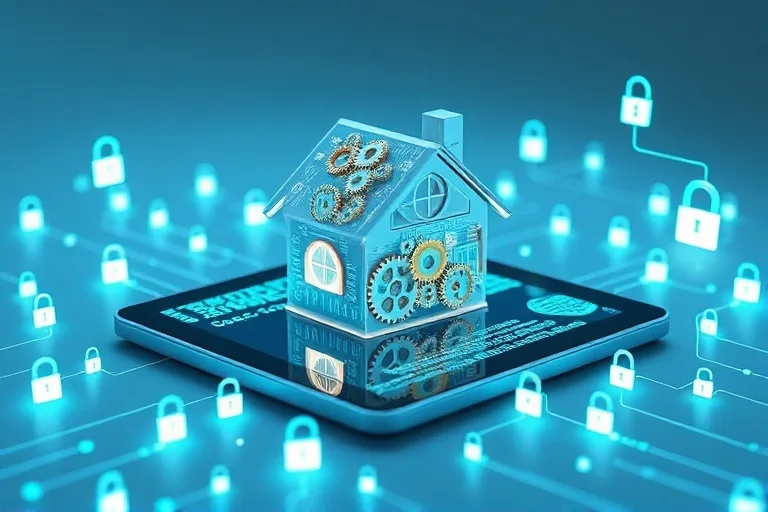
A stylized house icon, integrated with gears and circuit patterns, symbolizes the secure and automated nature of digital property transactions.
Key Benefits of Smart Contracts in Real Estate
The integration of smart contracts into the real estate sector offers a multitude of advantages that can redefine how properties are bought, sold, and managed.
- Automation: Smart contracts automate the execution of contractual clauses, reducing manual effort and the need for intermediaries like lawyers, notaries, and escrow agents. This automation accelerates the transaction process significantly.
- Enhanced Security: Operating on a blockchain, smart contracts benefit from cryptographic security. Once recorded, the terms and transactions are immutable and tamper-proof, drastically reducing the risk of fraud, manipulation, or unauthorized changes.
- Transparency: All parties involved in a smart contract can view the terms and the status of the agreement on the blockchain. This transparency fosters trust and reduces information asymmetry, as everyone has access to the same, verified data.
- Increased Efficiency: By automating processes and eliminating intermediaries, smart contracts can dramatically cut down the time required to complete a real estate transaction, from weeks or months to potentially days or even hours.
- Cost Reduction: The removal of various intermediaries and the automation of administrative tasks lead to significant cost savings for both buyers and sellers, reducing fees associated with legal services, escrow, and brokerage.
- Reduced Errors: Human error is a common source of complications in traditional contracts. Smart contracts, once coded and verified, execute precisely as programmed, minimizing mistakes and inconsistencies.
- Fractional Ownership: Smart contracts facilitate the tokenization of real estate, allowing properties to be divided into smaller, tradable digital tokens. This enables fractional ownership, making real estate investment more accessible and liquid for a broader range of investors.
Practical Use Cases and Applications
Beyond the core transaction of buying and selling, smart contracts can be applied to numerous other aspects of real estate:
- Property Transfers: The most direct application, where property ownership is transferred digitally and securely upon fulfillment of payment conditions.
- Escrow Services: Smart contracts can act as automated escrow agents, holding funds or assets until all contractual obligations are met by both parties, then releasing them automatically.
- Real Estate Financing: Mortgage agreements can be structured as smart contracts, automating loan disbursements, interest payments, and lien releases.
- Rental Agreements: Smart contracts can manage rental payments, security deposits, and even trigger maintenance requests if certain conditions (e.g., sensor data indicating a fault) are met.
- Property Management: Automation of service payments, utility bills, and access control for properties.
- Fractional Ownership and Crowdfunding: Enabling multiple investors to collectively own a portion of a high-value property through tokenized shares, simplifying management and profit distribution.
Challenges and Limitations to Adoption
Despite their immense potential, smart contracts face several hurdles that need to be overcome for widespread adoption in real estate.
- Legal Recognition and Enforceability: One of the biggest challenges is the varying legal status of smart contracts across different jurisdictions. While some countries are beginning to recognize them, a universal legal framework is still lacking.
- Scalability and Interoperability: Current blockchain networks can face scalability issues, impacting transaction speed and cost. Furthermore, integrating smart contracts with existing legacy systems and other blockchain networks remains a complex challenge.
- Security of Code and Oracles: Smart contracts are only as secure as their code. Bugs or vulnerabilities in the code can lead to significant financial losses. Additionally, smart contracts often rely on "oracles" (external data feeds) to get real-world information, and the integrity of these oracles is crucial.
- Human Error in Coding: While smart contracts automate execution, the initial coding is done by humans, making them susceptible to errors or ambiguities that can lead to unintended consequences once deployed.
- Irreversibility: The immutable nature of blockchain, while a strength, also means that once a smart contract is executed, it cannot be easily reversed or modified, even in cases of error or unforeseen circumstances.
- User Adoption and Education: The complexity of blockchain and smart contracts can be a barrier for mainstream users and traditional real estate professionals who may lack the technical understanding.

An abstract representation of a secure data pipeline, with crystalline blocks and glowing data packets, illustrating the integrity of blockchain transactions.
Legal and Regulatory Framework
The legal recognition and regulatory oversight of smart contracts are critical for their widespread adoption. Currently, the legal landscape is fragmented, with different jurisdictions taking varied approaches.
In some regions, legislation has been introduced to grant smart contracts legal enforceability, treating them similarly to traditional contracts if they meet certain criteria.
For instance, states like Arizona and Ohio in the U.S. have passed laws recognizing the legal validity of smart contracts and blockchain records. The Uniform Law Commission (ULC) has also developed the Uniform Electronic Transactions Act (UETA) and the Uniform Commercial Code (UCC) amendments to address electronic records and transferable records, which could extend to smart contracts.
However, many legal systems still grapple with how to apply existing contract law principles—such as offer, acceptance, consideration, and intent—to self-executing code. Issues like dispute resolution, liability in case of code errors, and the legal implications of immutability need further clarification and standardization.
As the technology matures, it is expected that more robust and harmonized legal frameworks will emerge, providing the necessary certainty for businesses and individuals to confidently utilize smart contracts in real estate. This will likely involve a collaborative effort between legal experts, technologists, and policymakers to bridge the gap between code and law.
Future Outlook and Integration with Emerging Technologies
The future of smart contracts in real estate is bright, with continuous innovation promising to address current limitations and unlock new possibilities. We can anticipate several key developments:
- Interoperability Solutions: Efforts to create seamless communication between different blockchain networks will enhance the utility of smart contracts, allowing for more complex cross-chain transactions.
- Advanced Oracle Networks: More secure and reliable oracle solutions will be developed to feed accurate real-world data into smart contracts, reducing the risk of manipulation.
- Integration with IoT: Smart contracts could integrate with Internet of Things (IoT) devices in smart homes and buildings. For example, a smart contract could automatically release a security deposit based on sensor data verifying the property's condition upon lease termination.
- AI and Machine Learning: Artificial intelligence could be used to analyze smart contract code for vulnerabilities, optimize contract terms, or even assist in the creation of more sophisticated contractual agreements.
- Digital Identity Verification: Enhanced digital identity solutions will streamline KYC (Know Your Customer) and AML (Anti-Money Laundering) processes, making property transactions even more secure and compliant.
- Decentralized Autonomous Organizations (DAOs): DAOs could manage real estate portfolios, with smart contracts governing collective decision-making and asset management, especially for fractional ownership models.
These advancements will collectively pave the way for a more efficient, transparent, and accessible real estate ecosystem, fundamentally changing how we perceive and interact with property ownership.
Conclusion: The Future of Property Transactions
Smart contracts represent a paradigm shift for the real estate industry, offering a powerful combination of automation, security, and transparency that can address many of the inefficiencies and trust issues inherent in traditional processes. While significant challenges remain, particularly in the legal and regulatory spheres, ongoing technological developments and increasing industry interest suggest that smart contracts will play an increasingly vital role in property transactions.
As blockchain technology matures and legal frameworks adapt, the vision of fully automated, secure, and transparent real estate dealings moves closer to reality. Embracing this innovation will not only streamline operations and reduce costs but also democratize access to real estate investment, ultimately benefiting all participants in the market.
Fuente: Contenido híbrido asistido por IAs y supervisión editorial humana.


Comentarios