
DevSecOps Cloud Integration: Secure Software Development
In the rapidly evolving landscape of cloud computing, the integration of security into every phase of the software development lifecycle has become not just a best practice, but a critical necessity. This approach, known as DevSecOps, extends the principles of DevOps by embedding security considerations from the initial design phase through development, testing, deployment, and ongoing operations. For organizations leveraging cloud-native architectures, DevSecOps offers a strategic framework to build resilient, compliant, and inherently secure applications at the speed demanded by modern markets.
The cloud environment, with its dynamic infrastructure, ephemeral resources, and shared responsibility models, introduces unique security challenges that traditional security paradigms often struggle to address effectively. DevSecOps provides a proactive and automated solution, transforming security from a bottleneck or an afterthought into an integral, continuous component of the development process. This comprehensive guide will explore the core concepts, principles, and practical applications of DevSecOps in the cloud, offering insights into how to cultivate a security-first culture and implement robust security measures.
Table of Contents
- Introduction to Cloud DevSecOps
- Why DevSecOps is Crucial in the Cloud
- Core Principles of Cloud DevSecOps
- Key DevSecOps Practices for Cloud Environments
- Essential Tools and Technologies
- Benefits and Challenges of Cloud DevSecOps
- Implementation Best Practices
- Future Trends in Cloud DevSecOps
- Conclusion

A collaborative team actively integrating security measures into a futuristic cloud software development environment, symbolizing the essence of DevSecOps.
Introduction to Cloud DevSecOps
DevSecOps represents a cultural, automation, and platform transformation that integrates security into the entire software delivery pipeline. It's an evolution of DevOps, emphasizing that security is not an isolated function but a shared responsibility across development, operations, and security teams. In a cloud context, this means leveraging cloud-native tools and automation to embed security checks, policies, and remediation actions directly into the continuous integration and continuous delivery (CI/CD) pipeline.
The goal is to "shift left," moving security considerations as early as possible in the development process, thereby identifying and mitigating vulnerabilities before they become costly problems in production. This proactive approach contrasts sharply with traditional security models, where security reviews often occur late in the cycle, leading to delays and expensive rework. Cloud DevSecOps aims to achieve rapid innovation without compromising the security posture of applications and infrastructure.
Why DevSecOps is Crucial in the Cloud
The adoption of cloud computing has brought unprecedented agility and scalability, but it also introduces a unique set of security challenges that necessitate a DevSecOps approach. Traditional perimeter-based security models are often inadequate for dynamic, distributed cloud environments. The shared responsibility model, where cloud providers manage the security *of* the cloud, and customers are responsible for security *in* the cloud, underscores the need for integrated security practices.
Cloud-native applications, built using microservices, containers, and serverless functions, often have a larger attack surface due to their distributed nature and numerous interdependencies. Misconfigurations, insecure APIs, and vulnerabilities in third-party components are common risks. DevSecOps addresses these by automating security checks, enforcing policies programmatically, and fostering a culture where security is everyone's concern, not just a dedicated team's.
Furthermore, the speed of cloud development and deployment means that vulnerabilities can be introduced and propagated rapidly if security is not integrated. DevSecOps helps maintain this velocity by making security an enabler rather than a blocker, ensuring that security measures scale with the application's growth and complexity. This integration helps organizations meet compliance requirements more efficiently and respond to threats with greater agility.
Core Principles of Cloud DevSecOps
Implementing DevSecOps in the cloud is guided by several fundamental principles that ensure security is deeply woven into the fabric of software delivery. These principles foster a proactive, collaborative, and automated approach to security.
- Shift Left: This is the cornerstone of DevSecOps. It means integrating security activities as early as possible in the software development lifecycle (SDLC). Instead of finding vulnerabilities late in the testing or production phases, security is embedded in design, coding, and initial testing. This reduces the cost and effort of remediation significantly.
- Automation: Manual security checks cannot keep pace with the speed of cloud development. Automation is critical for integrating security into CI/CD pipelines, enabling continuous security testing, vulnerability scanning, and policy enforcement without human intervention. This ensures consistency and reduces human error.
- Collaboration and Shared Responsibility: DevSecOps breaks down silos between development, security, and operations teams. Security becomes a shared responsibility, fostering a culture of open communication, knowledge sharing, and mutual understanding of security requirements and risks. Everyone contributes to building secure software.
- Continuous Everything: This principle extends the "continuous" aspects of DevOps (Continuous Integration, Continuous Delivery, Continuous Deployment) to include Continuous Security. This involves continuous monitoring, continuous testing, and continuous feedback loops to adapt security measures to evolving threats and application changes.
- Compliance as Code: In cloud environments, compliance requirements can be codified and automated. This means defining security policies and regulatory requirements in a machine-readable format, allowing them to be automatically checked and enforced throughout the pipeline. This ensures consistent adherence to standards like GDPR, HIPAA, or ISO 27001.
- Security by Design: Rather than patching security onto an existing application, DevSecOps advocates for designing security into the architecture from the outset. This involves threat modeling, secure coding practices, and architectural reviews to identify and mitigate potential risks early in the design phase.

A conceptual 3D render illustrating the seamless flow of security checks and digital safeguards within a cloud-native software development pipeline.
Key DevSecOps Practices for Cloud Environments
Implementing DevSecOps in the cloud involves a range of specific practices tailored to cloud-native architectures and the unique challenges they present. These practices ensure that security is an active participant throughout the entire application lifecycle.
- Infrastructure as Code (IaC) Security: Cloud infrastructure is often provisioned and managed using IaC tools like Terraform or CloudFormation. DevSecOps mandates scanning IaC templates for security misconfigurations and vulnerabilities before deployment. This ensures that the underlying infrastructure is secure from its inception.
- Container Security: For containerized applications (e.g., Docker, Kubernetes), security involves scanning container images for known vulnerabilities, ensuring secure base images, and implementing runtime security policies. Tools can automatically scan registries and block deployments of insecure images.
- Serverless Security: Serverless functions introduce unique security considerations, such as managing permissions, securing API gateways, and monitoring function execution. DevSecOps practices include least privilege access, code scanning for serverless functions, and robust logging and monitoring.
- CI/CD Pipeline Security: The CI/CD pipeline itself is a critical attack vector. Securing it involves implementing strong authentication and authorization, scanning build artifacts, integrating security tests at various stages, and ensuring the integrity of the pipeline. This includes static application security testing (SAST) and dynamic application security testing (DAST).
- Threat Modeling: Conducted early in the design phase, threat modeling identifies potential threats and vulnerabilities in an application's architecture. This proactive analysis helps developers and security teams design security controls to mitigate identified risks before any code is written.
- Vulnerability Management: Continuous scanning for vulnerabilities in code, dependencies, and deployed applications is essential. This includes software composition analysis (SCA) to identify vulnerabilities in open-source libraries and regular penetration testing.
- Secrets Management: Securely managing API keys, database credentials, and other sensitive information is paramount. DevSecOps integrates secrets management solutions (e.g., HashiCorp Vault, AWS Secrets Manager) to prevent hardcoding secrets and ensure they are accessed securely.
- Runtime Security and Monitoring: Even with robust pre-deployment security, continuous monitoring of cloud applications and infrastructure in production is vital. This includes logging, intrusion detection, security information and event management (SIEM) integration, and automated incident response capabilities to detect and react to threats in real-time.
- Compliance and Governance: Automating compliance checks and policy enforcement ensures that applications adhere to regulatory standards and internal security policies. This can involve policy-as-code frameworks that automatically audit cloud resources against defined rules.
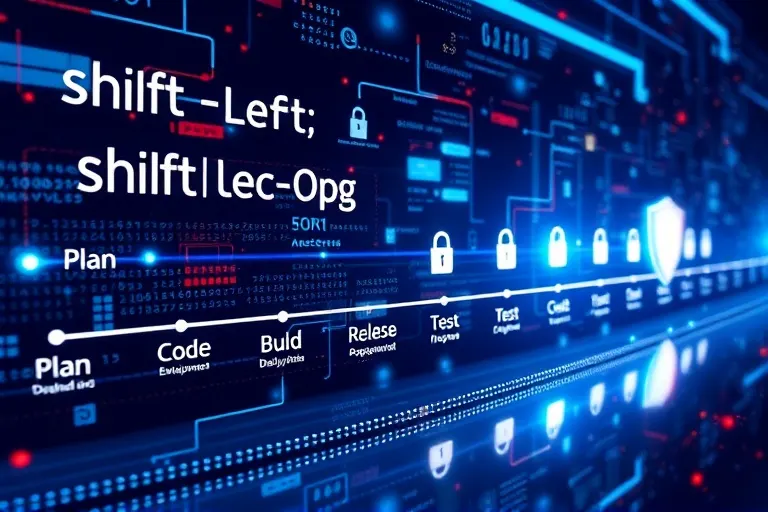
A clear vector art infographic demonstrating the "shift left" approach, where security activities are integrated earlier into the software development lifecycle.
Essential Tools and Technologies
A successful DevSecOps implementation in the cloud relies heavily on a robust set of tools that automate security tasks and integrate seamlessly into the CI/CD pipeline. These tools span various stages of the development lifecycle, from code analysis to runtime protection.
| Category | Examples of Tools | Functionality |
|---|---|---|
| Static Application Security Testing (SAST) | SonarQube, Checkmarx, Fortify | Analyzes source code for vulnerabilities without executing it. |
| Dynamic Application Security Testing (DAST) | OWASP ZAP, Burp Suite, Acunetix | Tests running applications for vulnerabilities by simulating attacks. |
| Software Composition Analysis (SCA) | Black Duck, Snyk, Dependabot | Identifies vulnerabilities in open-source components and libraries. |
| Infrastructure as Code (IaC) Security | Terraform, CloudFormation, Checkov, Kics | Scans IaC templates for misconfigurations and security policy violations. |
| Container Security | Clair, Trivy, Aqua Security, Twistlock (Palo Alto Networks) | Scans container images for vulnerabilities and enforces runtime policies. |
| Secrets Management | HashiCorp Vault, AWS Secrets Manager, Azure Key Vault | Securely stores and manages sensitive credentials and API keys. |
| Cloud Security Posture Management (CSPM) | CloudGuard (Check Point), Prisma Cloud (Palo Alto Networks), Wiz | Continuously monitors cloud environments for misconfigurations and compliance. |
| Security Information and Event Management (SIEM) | Splunk, Elastic SIEM, Microsoft Sentinel | Aggregates and analyzes security logs and events for threat detection. |
| Web Application Firewall (WAF) | AWS WAF, Cloudflare WAF, Akamai WAF | Protects web applications from common web exploits. |
The selection of tools should align with the organization's specific cloud provider (AWS, Azure, GCP), existing technology stack, and security requirements. Integration capabilities are key to ensuring a seamless and automated DevSecOps pipeline.
Benefits and Challenges of Cloud DevSecOps
Adopting DevSecOps in the cloud offers significant advantages, but also comes with its own set of challenges that organizations must address strategically.
Benefits:
- Enhanced Security Posture: By integrating security early and continuously, vulnerabilities are identified and remediated faster, leading to more secure applications and infrastructure.
- Faster Time to Market: Automated security checks prevent security from becoming a bottleneck, allowing development teams to release features more quickly and frequently without compromising safety.
- Reduced Costs: Fixing security flaws earlier in the SDLC is significantly cheaper than addressing them in production. DevSecOps minimizes rework and reduces the likelihood of costly breaches.
- Improved Compliance: Automation of policy enforcement and continuous monitoring helps organizations maintain compliance with regulatory requirements more easily and consistently.
- Stronger Collaboration: Breaking down silos between teams fosters a culture of shared responsibility, leading to better communication, knowledge transfer, and a more cohesive approach to security.
- Greater Agility and Resilience: Applications are built with security in mind from the ground up, making them more resilient to attacks and easier to adapt to new security threats.
Challenges:
- Cultural Shift: Moving from a traditional, siloed approach to a collaborative, security-first mindset requires significant cultural change, which can be difficult to achieve.
- Complexity of Cloud Environments: The dynamic and distributed nature of cloud-native applications, coupled with the vast array of cloud services, can make comprehensive security challenging.
- Tool Sprawl and Integration: Selecting, integrating, and managing numerous security tools across different stages of the pipeline can be complex and resource-intensive.
- Skill Gap: There is often a shortage of professionals with expertise in both cloud development and security, making it challenging to build and maintain DevSecOps teams.
- False Positives: Automated security scanning tools can generate a high number of false positives, requiring manual review and potentially slowing down the pipeline if not properly managed.
- Balancing Speed and Security: Finding the right balance between rapid development cycles and thorough security checks requires careful planning and continuous optimization.
Implementation Best Practices
Successfully implementing DevSecOps in a cloud environment requires a strategic approach that addresses both technical and cultural aspects. Here are some best practices:
- Start Small and Iterate: Begin with a pilot project or a specific application to demonstrate the value of DevSecOps before scaling it across the organization. Learn from initial implementations and continuously improve.
- Foster a Security Culture: Educate and train development, operations, and security teams on DevSecOps principles and practices. Encourage shared ownership of security and open communication.
- Automate Everything Possible: Prioritize automation for security testing, policy enforcement, and vulnerability remediation. Integrate security tools directly into the CI/CD pipeline to ensure continuous security.
- Leverage Cloud-Native Security Services: Utilize the security features and services offered by your cloud provider (e.g., IAM, WAF, KMS, security groups) to enhance your security posture.
- Implement Policy as Code: Define security policies in a machine-readable format that can be automatically enforced and audited across your cloud infrastructure and applications.
- Conduct Regular Threat Modeling: Integrate threat modeling into the early design phases of new features or applications to proactively identify and mitigate potential security risks.
- Secure the CI/CD Pipeline Itself: Ensure that your build and deployment pipelines are secure, with proper access controls, secrets management, and integrity checks.
- Monitor Continuously: Implement robust logging, monitoring, and alerting for all cloud resources and applications. Use SIEM solutions to aggregate and analyze security events for real-time threat detection.
- Establish Clear Metrics and Feedback Loops: Define key performance indicators (KPIs) for security, such as vulnerability detection rates, remediation times, and compliance scores. Use these metrics to drive continuous improvement.
- Embrace Immutable Infrastructure: Deploy infrastructure that cannot be changed after it's provisioned. Any updates require deploying a new, patched version, reducing configuration drift and enhancing security.
Future Trends in Cloud DevSecOps
The field of DevSecOps in the cloud is constantly evolving, driven by advancements in technology and the increasing sophistication of cyber threats. Several key trends are shaping its future.
One significant trend is the increased adoption of Artificial Intelligence (AI) and Machine Learning (ML) in security tools. AI/ML can enhance threat detection, reduce false positives, and automate incident response by analyzing vast amounts of security data more efficiently than humans. This will lead to more intelligent and predictive security operations.
Another emerging area is the focus on supply chain security. As applications rely heavily on open-source components and third-party libraries, securing the entire software supply chain, from code origin to deployment, becomes paramount. This includes advanced software bill of materials (SBOM) generation and continuous verification of component integrity. Furthermore, the rise of "security as code" will see more security policies, configurations, and even security tests defined and managed entirely through code, enabling even greater automation and consistency across diverse cloud environments.
Conclusion
DevSecOps in the cloud is no longer an optional enhancement but a fundamental requirement for organizations seeking to innovate rapidly and securely. By embedding security into every stage of the software development lifecycle, from design to operations, businesses can build resilient cloud-native applications that meet stringent compliance standards and withstand evolving cyber threats. The "shift left" philosophy, coupled with extensive automation and a culture of shared responsibility, transforms security from a reactive bottleneck into a proactive enabler of business agility.
While challenges such as cultural resistance and the complexity of cloud environments exist, the benefits of enhanced security, faster time to market, and reduced costs far outweigh them. Embracing DevSecOps is a continuous journey of improvement, requiring ongoing investment in tools, training, and cultural transformation. As cloud computing continues to dominate the technological landscape, a robust DevSecOps strategy will be the cornerstone of secure and successful digital transformation.
Source: Hybrid content assisted by AIs and human editorial supervision.


Comentarios