
Common Good Economy: Emerging Markets Social Impact
Common Good Economy in Emerging Markets: Business Models with Social Impact
The Common Good Economy (CGE), also known as the Economy for the Common Good (ECG), represents a transformative economic model that prioritizes social and ecological well-being over mere financial profit. It proposes a framework where businesses measure their success not only by monetary gains but also by their contributions to human dignity, solidarity, ecological sustainability, social justice, and democratic co-determination. This paradigm shift is gaining significant traction globally, offering a compelling alternative to conventional capitalism, particularly in regions grappling with persistent inequalities and environmental degradation.

A bustling market in a developing nation showcases ethical commerce and community spirit.
In emerging markets, the principles of the Common Good Economy hold particular relevance. These economies often face unique challenges, including high levels of poverty, informal labor sectors, limited access to essential services, and acute vulnerability to climate change impacts. By adopting CGE principles, businesses in these regions can foster inclusive growth, build resilient communities, and contribute to a more equitable and sustainable future. This article delves into the foundational concepts of the Common Good Economy and explores how its business models can generate profound social impact within the dynamic context of emerging markets.
Table of Contents
- Understanding the Common Good Economy
- Core Principles of the Common Good Economy
- Challenges and Opportunities in Emerging Markets
- Innovative Business Models with Social Impact
- Measuring Impact and Policy Support
- The Future of Ethical Business in Developing Nations
Understanding the Common Good Economy
The Common Good Economy is not merely a set of ethical guidelines but a comprehensive economic system designed to align business activities with societal values. Developed by Austrian economist Christian Felber, it provides a practical framework for businesses, municipalities, and educational institutions to assess and improve their contributions to the common good. Unlike traditional economic models that focus primarily on Gross Domestic Product (GDP) as a measure of success, the CGE introduces the "Common Good Balance Sheet" as a tool for evaluating ethical performance.
This balance sheet encourages organizations to transparently report on their interactions with stakeholders, including employees, suppliers, customers, the environment, and the wider community. The ultimate goal is to create an economy where competition is replaced by cooperation, and where success is defined by how well an entity serves the collective welfare. This approach moves beyond Corporate Social Responsibility (CSR) by integrating ethical considerations into the very core of business operations and strategic decision-making.
The Common Good Economy aims to transform the economic system from a profit-driven model to one that prioritizes the well-being of people and the planet. It challenges the conventional understanding of success and advocates for a more holistic approach to economic activity.
This framework is particularly relevant in contexts where market failures exacerbate social and environmental problems, offering a structured way for businesses to become part of the solution rather than contributing to the issue.
Core Principles of the Common Good Economy
The Common Good Economy is built upon a foundation of five core values that guide all economic activities. These principles are interconnected and serve as benchmarks against which businesses can measure their impact. Adhering to these values helps organizations create positive externalities and minimize negative ones, fostering a more sustainable and equitable society.
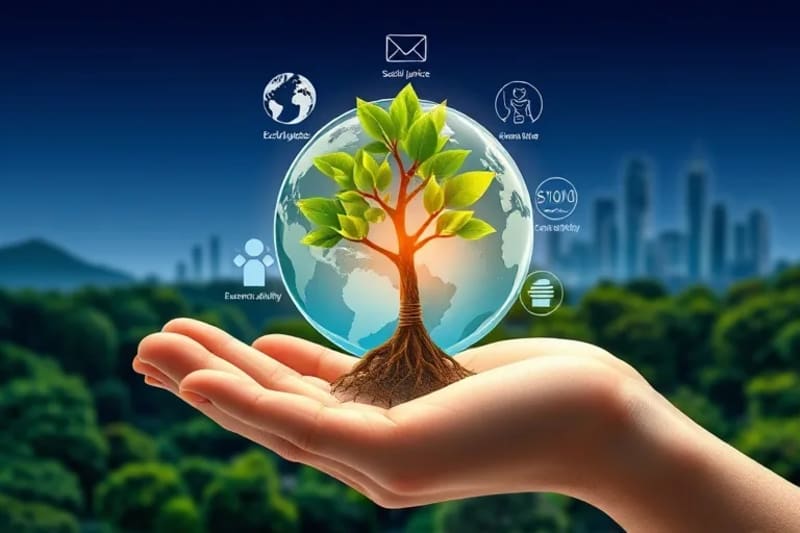
Symbolic representation of the interconnected principles driving the Common Good Economy.
The five core principles are:
- Human Dignity: This principle emphasizes treating all individuals with respect, ensuring fair labor practices, promoting diversity and inclusion, and upholding human rights throughout the supply chain. It means creating working conditions that allow employees to thrive and feel valued.
- Solidarity and Social Justice: Businesses are encouraged to contribute to a just distribution of wealth and opportunities. This includes fair wages, supporting local communities, engaging in ethical sourcing, and actively working to reduce social inequalities.
- Ecological Sustainability: This principle mandates responsible stewardship of natural resources. It involves minimizing environmental footprints, adopting circular economy practices, reducing waste, conserving energy, and promoting biodiversity.
- Transparency and Co-determination: Openness in business operations and decision-making is crucial. This includes clear communication with stakeholders, democratic participation in the workplace, and accountability for actions.
- Trust and Ethical Conduct: Building trust with all stakeholders through honesty, integrity, and ethical behavior is paramount. This fosters long-term relationships and a positive reputation, contributing to overall societal well-being.
By integrating these principles, businesses can move beyond superficial CSR initiatives to embed ethical considerations deeply within their organizational culture and operational strategies. This holistic approach ensures that economic activities genuinely serve the common good.
Challenges and Opportunities in Emerging Markets
Emerging markets present a unique landscape for the implementation of the Common Good Economy. While they offer immense opportunities for innovative social impact, they also come with distinct challenges that require tailored approaches. Understanding these dynamics is crucial for successful integration of CGE principles.
Key Challenges:
- Informal Economy: A significant portion of economic activity in emerging markets occurs in the informal sector, making it challenging to implement formal ethical standards and regulations.
- Governance and Corruption: Weak governance structures and pervasive corruption can hinder transparent and ethical business practices, diverting resources and undermining trust.
- Access to Finance: Social enterprises and ethical businesses often struggle to secure funding from traditional financial institutions, which prioritize short-term profits.
- Infrastructure Deficiencies: Inadequate infrastructure, including transportation, energy, and digital connectivity, can impede the growth and scalability of sustainable business models.
- Poverty and Inequality: High levels of poverty and income inequality create urgent social needs, but also limit purchasing power for ethically produced goods and services.
- Environmental Vulnerability: Many emerging markets are disproportionately affected by climate change, requiring significant investment in resilient and sustainable practices.

A conceptual balance scale illustrating the delicate equilibrium of ethical business in developing nations.
Key Opportunities:
- Leapfrogging Traditional Models: Emerging markets can bypass outdated, unsustainable industrial practices and directly adopt advanced, green technologies and ethical business models.
- Strong Community Ties: Many emerging societies have strong communal bonds and traditional systems of mutual support, which align well with CGE principles of solidarity and co-determination.
- Innovation for Local Needs: Entrepreneurs are often driven by a deep understanding of local challenges, leading to highly innovative solutions that address specific social and environmental needs.
- Growing Awareness: There is increasing consumer and governmental awareness regarding sustainability and ethical consumption, creating a demand for CGE-aligned products and services.
- Demographic Dividend: A large, young population can be a powerful force for change, driving demand for ethical employment and sustainable lifestyles.
- Impact Investing Growth: The rise of impact investing provides new avenues for funding social enterprises, though access remains a challenge.
Navigating these challenges while leveraging opportunities requires a nuanced understanding of local contexts and a commitment to long-term, sustainable development. The Common Good Economy offers a robust framework to guide these efforts effectively.
Innovative Business Models with Social Impact
The Common Good Economy encourages the development of business models that inherently generate social and environmental value. These models go beyond traditional profit maximization, embedding positive impact into their core operations. In emerging markets, such models are vital for addressing systemic issues and fostering sustainable development.
Examples of Impact-Driven Business Models:
- Social Enterprises: These businesses are founded with a primary social or environmental mission, using commercial strategies to achieve their goals. Examples include microfinance institutions, affordable healthcare providers, and educational initiatives targeting underserved communities.
- Cooperatives: Member-owned and democratically controlled organizations that prioritize the needs of their members and communities over profit. Agricultural cooperatives, housing cooperatives, and worker cooperatives are common in emerging markets, fostering solidarity and economic empowerment.
- Fair Trade Initiatives: Businesses committed to ethical sourcing, ensuring fair wages, safe working conditions, and environmental sustainability for producers in developing countries. This model directly addresses exploitation and promotes dignified livelihoods.
- Circular Economy Businesses: Models focused on minimizing waste and maximizing resource efficiency by designing products for durability, reuse, repair, and recycling. This is particularly impactful in regions with limited waste management infrastructure.
- Inclusive Business Models: Companies that integrate low-income communities into their value chains as customers, suppliers, distributors, or employees. This expands market access and creates economic opportunities for marginalized populations.
- Renewable Energy Solutions: Enterprises providing affordable and accessible clean energy solutions, such as solar home systems or mini-grids, to off-grid communities, reducing reliance on fossil fuels and improving quality of life.
These models demonstrate that economic viability and social impact are not mutually exclusive. Instead, they can be synergistic, driving both financial returns and significant contributions to the common good. The success of these ventures often depends on strong community engagement and innovative approaches to resource mobilization.
Measuring Impact and Policy Support
A crucial aspect of the Common Good Economy is the rigorous measurement of social and ecological impact. Without clear metrics, it is difficult to assess progress, ensure accountability, and attract impact-oriented investment. The Common Good Balance Sheet serves as a primary tool for this purpose, but other frameworks also play a vital role.
Impact Measurement Frameworks:
- Common Good Balance Sheet: A comprehensive matrix that evaluates a company's performance across the five CGE principles, detailing its interactions with various stakeholders.
- Sustainable Development Goals (SDGs): The United Nations' 17 SDGs provide a global blueprint for sustainable development, offering a universal language for impact reporting. Businesses can align their activities and report on their contributions to specific goals.
- B Corp Certification: A certification for companies that meet high standards of verified social and environmental performance, public transparency, and legal accountability to balance profit and purpose.
- Social Return on Investment (SROI): A methodology for measuring and accounting for a broad range of values that are not captured in conventional financial statements, including social, environmental, and economic outcomes.
Role of Policy and Regulatory Support:
For the Common Good Economy to flourish in emerging markets, supportive policy and regulatory frameworks are essential. Governments can play a pivotal role in creating an enabling environment for ethical businesses.
- Legal Recognition: Establishing legal forms for social enterprises and benefit corporations can provide clarity and legitimacy.
- Incentives: Offering tax breaks, subsidies, or preferential procurement policies for CGE-aligned businesses can encourage their growth.
- Access to Finance: Creating dedicated funds, guarantee schemes, or partnerships with development banks to provide patient capital for social impact ventures.
- Capacity Building: Supporting training programs, incubators, and accelerators for social entrepreneurs to enhance their business and impact measurement skills.
- Public Awareness: Promoting the benefits of the Common Good Economy to consumers and businesses through public campaigns and educational initiatives.
Strong policy support can help overcome market failures and level the playing field for businesses that prioritize people and planet alongside profit. This creates a virtuous cycle where ethical practices are rewarded and replicated.
The Future of Ethical Business in Developing Nations
The trajectory of the Common Good Economy in emerging markets is one of immense potential. As global challenges like climate change, inequality, and resource scarcity intensify, the need for economic models that prioritize collective well-being becomes ever more critical. Emerging markets, with their dynamic populations and urgent needs, can become fertile ground for pioneering ethical business practices.
The increasing interconnectedness of the global economy means that ethical practices in one region can influence others. Consumers worldwide are becoming more discerning, demanding transparency and accountability from the brands they support. This growing demand, coupled with the inherent resilience and innovation often found in developing nations, positions the Common Good Economy as a powerful force for positive change.
The journey towards a fully realized Common Good Economy in emerging markets will undoubtedly face obstacles. However, the collaborative spirit, the focus on local solutions, and the commitment to holistic well-being inherent in this model provide a robust pathway forward. By embracing these principles, emerging economies can not only address their pressing social and environmental issues but also set a global example for a more just, sustainable, and prosperous future for all.
Fuente: Contenido híbrido asistido por IAs y supervisión editorial humana.


Comentarios