
Curl Boat Shape: Understanding Marine Curvature | Althox
The term "curl" in the context of boat shapes refers to an unintended curvature or deformation of a material, often a plank, sheet metal, or composite panel, that deviates from its intended flat or uniformly curved design. This phenomenon, distinct from the deliberate shaping of a hull, can significantly impact a vessel's structural integrity, hydrodynamic performance, and overall longevity. Understanding the causes and implications of such curling is paramount in naval architecture and marine engineering.
While a boat's hull is intentionally designed with specific curves and contours to optimize hydrodynamics and stability, "curl" describes an undesirable warping, twisting, or concaving that occurs due to various internal and external stresses. This article delves into the multifaceted nature of this marine phenomenon, exploring its origins, effects, and the strategies employed to prevent or mitigate its occurrence.
- Understanding "Curl" in Marine Design
- Materials and Their Susceptibility to Curling
- Causes of Unintended Curvature
- Impact of Curling on Boat Performance and Safety
- Prevention and Mitigation Strategies
- Advanced Concepts: Controlled Curvature and Smart Materials
Understanding "Curl" in Marine Design
In the realm of marine construction, "curl" refers to an unintentional and often localized distortion of a material's surface or overall form. This deviation can manifest in various ways, such as a board bowing outwards, a metal sheet developing ripples, or a composite panel losing its intended flatness. It is a critical distinction to make between a designed curve, which contributes to a boat's functionality, and an unwanted curl, which compromises it.
The implications of curl extend beyond mere aesthetics. A curled component can introduce stress concentrations, alter hydrodynamic flow, and ultimately reduce the structural integrity and lifespan of a vessel. Naval architects and marine engineers meticulously design boats to withstand dynamic forces, and any unforeseen deformation like curl can undermine these calculations, potentially leading to catastrophic failures.
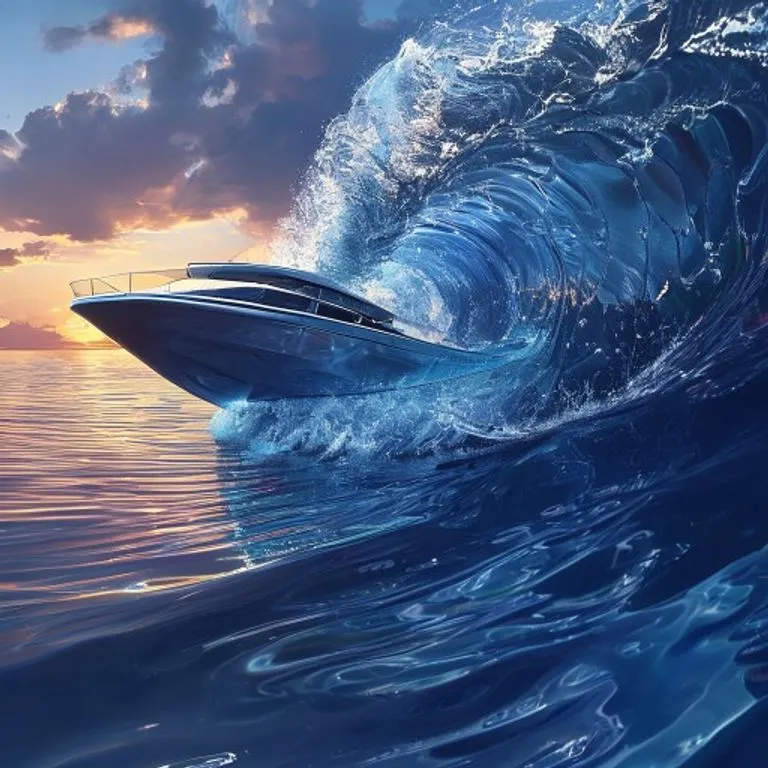
 A visual representation of an unintended curvature or hull deformation, illustrating the concept of "curl" in marine structures.
The precise definition of "curl" can vary slightly depending on the material and context. For wood, it often implies warping or cupping. For metals, it might be buckling or oil-canning. In composites, it could refer to delamination or localized stress-induced bending. Regardless of its specific manifestation, the underlying principle remains the same: an undesirable change in shape that impacts performance and safety.
Materials and Their Susceptibility to Curling
Different materials used in boat construction exhibit varying degrees of susceptibility to curling, largely due to their inherent properties and how they react to environmental and mechanical stresses. Understanding these material-specific behaviors is crucial for selecting appropriate construction methods and ensuring long-term durability.
Wood
Wood, a traditional boat-building material, is particularly prone to curling, warping, and cupping. This is primarily due to its hygroscopic nature, meaning it readily absorbs and releases moisture from the environment. As moisture content changes, wood expands and contracts unevenly across its grain, leading to internal stresses that manifest as deformation. Proper seasoning, sealing, and lamination techniques are essential to mitigate this.
Metals
Metals like aluminum and steel, while strong, can also experience curling, especially during fabrication processes such as welding. The localized heat input from welding causes differential expansion and contraction, leading to residual stresses that can warp or buckle metal sheets. Thermal cycling in service can exacerbate these issues. Advanced welding techniques and stress-relieving processes are employed to minimize metal curl.
Composites
Fiber-reinforced polymer (FRP) composites, widely used in modern boat building, can also exhibit curling, often referred to as print-through or post-cure distortion. This is frequently linked to the curing process of the resin, where uneven shrinkage or temperature gradients can induce internal stresses within the laminate. The orientation of fibers and the thickness of layers also play a significant role in a composite's resistance to curling.
The interaction between different materials in a boat's structure can also contribute to curling. For instance, if a wooden component is rigidly attached to a composite one, and they expand or contract at different rates, one or both materials may experience induced curl. This highlights the importance of holistic design and material compatibility in marine engineering.
Causes of Unintended Curvature
The causes of unintended curvature or "curl" in boat components are diverse, stemming from a combination of environmental factors, manufacturing processes, and structural stresses. A comprehensive understanding of these root causes is essential for effective prevention and remediation.
 The subtle distortion of a wooden plank, demonstrating how wood warping can manifest due to environmental factors.
Environmental Factors
- Moisture Content: Fluctuations in humidity are a primary cause of wood warping. Uneven moisture absorption or drying across a board creates differential stresses, leading to cupping or bowing.
- Temperature Gradients: Significant temperature differences across a material can cause uneven expansion and contraction. This is particularly relevant for large metal or composite panels exposed to direct sunlight on one side and cooler temperatures on the other.
- UV Radiation: Prolonged exposure to ultraviolet light can degrade the surface layers of certain materials, especially plastics and some composites, leading to changes in their mechanical properties and increased susceptibility to deformation.
Manufacturing Processes
- Improper Curing: In composite manufacturing, insufficient or uneven curing of resins can leave residual stresses that cause panels to curl over time. Incorrect temperature profiles or premature demolding are common culprits.
- Uneven Pressure: During the lamination of wood or composites, inconsistent pressure application can result in areas of higher or lower density, leading to internal stresses and subsequent deformation.
- Material Defects: Internal flaws, such as knots in wood, inclusions in metal, or voids in composites, can create weak points or areas of differential stress that initiate or exacerbate curling.
- Welding and Heat Treatment: As mentioned, the localized heat from welding can induce significant residual stresses in metals, causing them to warp or curl. Improper heat treatment can also alter material properties and lead to distortion.
Structural Stress
- Uneven Loads: Prolonged, uneven loading on a boat's deck or hull can cause components to sag or curl over time, especially if the underlying structure is insufficient.
- Impact and Vibration: Repeated impacts from waves or constant vibrations from machinery can induce fatigue and localized plastic deformation, contributing to the curling of panels or structural elements.
- Fastener Stress: Over-tightening fasteners or using an insufficient number of fasteners can create localized stress points that lead to material deformation around the attachment points.
Understanding the interplay of these factors is critical for diagnosing and addressing curling issues in marine vessels. Often, multiple causes contribute to the problem, requiring a holistic approach to both prevention and repair.
Impact of Curling on Boat Performance and Safety
The presence of unwanted curl in a boat's structure or surfaces can have a detrimental impact on various aspects, ranging from its hydrodynamic efficiency to its overall safety and long-term value. These effects are often cumulative and can accelerate the degradation of the vessel.
Hydrodynamics and Performance
A smooth and precisely shaped hull is crucial for efficient water flow and minimal drag. Any unintended curl, particularly on the underwater sections of the hull or appendages, can disrupt laminar flow, increase turbulence, and consequently reduce speed and fuel efficiency. This can be especially problematic for high-performance vessels where every fraction of drag matters.
- Increased Drag: Curled surfaces create eddies and turbulence, significantly increasing the resistance a boat experiences as it moves through water.
- Altered Handling Characteristics: Deformations can subtly change the boat's center of effort or lateral resistance, leading to unpredictable steering, reduced stability, or an increased tendency to list.
- Reduced Speed and Fuel Economy: The increased drag directly translates to a need for more power to maintain speed, resulting in higher fuel consumption and slower overall performance.
Structural Integrity and Safety
Perhaps the most critical consequence of curling is its effect on the structural integrity of the boat. Curl indicates that internal stresses are present, which can weaken the material and make it more susceptible to failure under load. This poses significant safety risks.
- Stress Concentrations: A curled section will have areas where stress is concentrated, making it more prone to cracking, fatigue, or catastrophic failure, especially in dynamic marine environments.
- Reduced Load-Bearing Capacity: The deformed material may not be able to bear its intended loads, compromising the structural strength of the hull, deck, or other components.
- Water Ingress: Curling can create gaps or open up seams, allowing water to penetrate the boat's structure, leading to rot in wood, corrosion in metal, or delamination in composites, further degrading the vessel.
- Delamination in Composites: In FRP structures, curl can be a symptom or cause of delamination, where layers of the composite separate, severely compromising its strength.
 An artistic representation of material stress and deformation, illustrating the internal forces that lead to curling.
Aesthetics and Resale Value
While less critical than safety, the aesthetic impact of curling can significantly diminish a boat's appeal and resale value. A visibly warped deck, rippled hull, or uneven panels detract from the craftsmanship and perceived quality of the vessel. Potential buyers are often wary of boats showing signs of structural issues, even if they are only superficial.
In summary, curl is not merely a cosmetic flaw; it is a serious indicator of underlying material stress and structural compromise that can profoundly affect a boat's performance, safety, and economic value. Addressing and preventing curl is therefore a critical aspect of responsible boat design, construction, and maintenance.
Prevention and Mitigation Strategies
Preventing and mitigating curl in boat shapes requires a multi-faceted approach, integrating careful material selection, robust design principles, precise manufacturing controls, and diligent ongoing maintenance. Each stage of a boat's lifecycle offers opportunities to address potential curling issues.
Material Selection and Treatment
- Wood: Selecting properly seasoned and quarter-sawn timber minimizes moisture-induced warping. Applying effective sealants and coatings provides a barrier against humidity fluctuations. Lamination with opposing grain patterns can also help stabilize wooden components.
- Metals: Using alloys with good dimensional stability and low residual stress is important. Stress-relieving heat treatments after welding or forming can significantly reduce internal stresses that lead to curling. Proper storage of metal sheets to prevent uneven loading is also crucial.
- Composites: Choosing resins with low shrinkage characteristics and reinforcing fibers with appropriate stiffness and orientation can reduce internal stresses. Pre-impregnated (pre-preg) materials, cured under controlled vacuum and temperature, often yield more stable laminates.
Design Considerations
- Stiffeners and Ribs: Incorporating strategically placed stiffeners, stringers, and ribs into hull and deck designs provides structural support that resists deformation. These elements distribute loads more evenly and prevent large, flat panels from curling.
- Balanced Laminates: In composite design, ensuring that laminate schedules are balanced and symmetrical helps to prevent internal stresses from accumulating and causing distortion. This means matching material properties and thicknesses on opposing sides of a neutral axis.
- Expansion Joints: For large structures, especially those exposed to significant thermal cycling, incorporating expansion joints can allow materials to expand and contract without inducing excessive stress and subsequent curl.
Manufacturing Controls
- Controlled Environments: Manufacturing in environments with controlled temperature and humidity helps to stabilize materials during processing, reducing the likelihood of curl.
- Precise Curing Cycles: For composites, adhering to precise curing schedules, including ramp-up, dwell, and cool-down phases, is critical to minimize residual stresses.
- Quality Control: Implementing rigorous quality control checks at various stages of production can identify potential issues early, before they lead to significant curling. This includes checking material flatness, measuring residual stress, and inspecting for defects.
Maintenance and Inspection
- Regular Inspections: Routine visual inspections can help detect early signs of curling or warping, allowing for timely intervention before the problem escalates.
- Environmental Control: Storing boats in covered or climate-controlled environments when not in use can protect them from extreme temperature and humidity fluctuations.
- Protective Coatings: Maintaining high-quality paint and gelcoat finishes provides an additional layer of protection against UV degradation and moisture absorption, especially for wooden and composite structures.
By integrating these strategies, boat builders and owners can significantly reduce the incidence of curl, thereby enhancing the vessel's performance, extending its lifespan, and preserving its value. Prevention is always more cost-effective than remediation when it comes to structural deformations.
Advanced Concepts: Controlled Curvature and Smart Materials
While "curl" generally refers to an undesirable deformation, the concept of controlled curvature is at the forefront of advanced marine design and material science. Engineers are now exploring ways to intentionally induce precise and reversible shape changes, often using "smart materials," to optimize boat performance or adapt to changing conditions. This represents a paradigm shift from merely preventing unwanted curl to actively harnessing shape modification for functional benefits.
One area of innovation involves morphing structures, where parts of a boat's hull or appendages can change shape in real-time to reduce drag, improve stability, or enhance maneuverability. This is analogous to how an aircraft wing can change its camber. Such controlled curvature could lead to significant advancements in fuel efficiency and operational flexibility for marine vessels.
Smart materials, such as shape memory alloys or electroactive polymers, are central to these developments. These materials can be programmed to change shape in response to external stimuli like temperature, electrical fields, or light. Integrating them into boat structures could allow for dynamic optimization of hull forms, active flow control, or even self-repairing capabilities, where minor deformations could be corrected automatically.
Furthermore, advanced computational modeling and simulation techniques are enabling designers to predict and control material behavior with unprecedented accuracy. Finite Element Analysis (FEA) and Computational Fluid Dynamics (CFD) allow engineers to simulate the effects of various forces and environmental conditions on complex geometries, ensuring that both intentional curves and the avoidance of unwanted curl are optimized from the outset. This intersection of material science, computational power, and innovative design promises a future where marine vessels are not only more efficient but also more resilient and adaptable.
The legal aspects surrounding material integrity and structural compliance in marine vessels are also stringent. For instance, international maritime organizations and national regulatory bodies establish strict standards for materials and construction to ensure safety and prevent structural failures, including those caused by uncontrolled curling. Adherence to these regulations, such as those outlined in the
is not just good practice but a legal imperative for all marine operations. These regulations often mandate specific testing protocols and certification processes for materials and components, ensuring they meet minimum performance criteria under various environmental stressors.International Convention for the Safety of Life at Sea (SOLAS)
and various national shipping acts,
In conclusion, while the traditional understanding of "curl" in boat shapes is associated with undesirable deformation, the future of marine engineering is moving towards a sophisticated control of curvature. This evolution promises vessels that are not only stronger and more durable but also dynamically adaptive, pushing the boundaries of what is possible on the water.
Fuente: Contenido híbrido asistido por IAs y supervisión editorial humana.


Comentarios