
Abada Rhinoceros: Philip II's Historic Beast | Althox
The name Abada evokes a fascinating blend of natural history, royal intrigue, and cultural etymology. At its core, Abada refers to a specific female Indian rhinoceros that resided in the menageries of two European monarchs during the late 16th century, first under Sebastian I of Portugal and later under Philip II of Spain. This animal represented a rare and exotic marvel in an era when direct observation of such creatures was limited to a privileged few.
Its presence in Europe was particularly significant, marking the first time a rhinoceros had been seen on the continent since the famous rhinoceros gifted by Manuel I of Portugal to Pope Leo X in 1515. That earlier rhino, tragically lost at sea, was immortalized through Albrecht Dürer's iconic woodcut, a representation that would influence European perceptions of the animal for centuries. Abada, therefore, carried the weight of this historical precedent, offering a new opportunity for direct study and public fascination.
- Rarity: Rhinoceroses were exceedingly rare in Europe, making Abada a prized possession.
- Historical Context: Her life spanned a period of significant European exploration and colonial expansion.
- Cultural Impact: Abada influenced contemporary art, literature, and even urban planning.
This article delves into the detailed history of Abada, from her arrival in Lisbon to her final days in El Escorial, exploring her impact on the Spanish court and broader European society. We will also examine the linguistic origins of the name "Abada" and its diverse applications across different cultures and contexts, highlighting how a single term can encompass such a rich tapestry of meanings.
Table of Contents
- Introduction: Abada, the Rhinoceros of Philip II
- Abada's Arrival in Europe: From India to Portugal
- Philip II's Acquisition and the Royal Menageries
- Life at El Escorial: Public Spectacle and Royal Pranks
- Controversies and Abada's Mysterious Fate
- Abada's Lasting Legacy and Cultural Impact
- Etymological Origins of the Name "Abada"
- Beyond the Rhinoceros: Other Meanings of "Abada"
- Conclusion: A Name Etched in History and Culture
Introduction: Abada, the Rhinoceros of Philip II
Abada, the Indian rhinoceros, holds a unique place in the annals of European natural history. Her story is not merely that of an exotic animal, but a narrative intertwined with the political and cultural landscape of 16th-century Iberia. She was a living testament to the expanding global reach of European powers, a symbol of royal prestige, and a subject of intense curiosity and scientific inquiry, albeit rudimentary for the time.
The name "Abada" itself is believed to derive from the Malay word "badak," a general term for rhinoceros. However, given her singular presence in Europe, it quickly became her proper name, distinguishing her from any other creature of her kind. This dual meaning—both a generic term and a specific identifier—underscores her unique status.
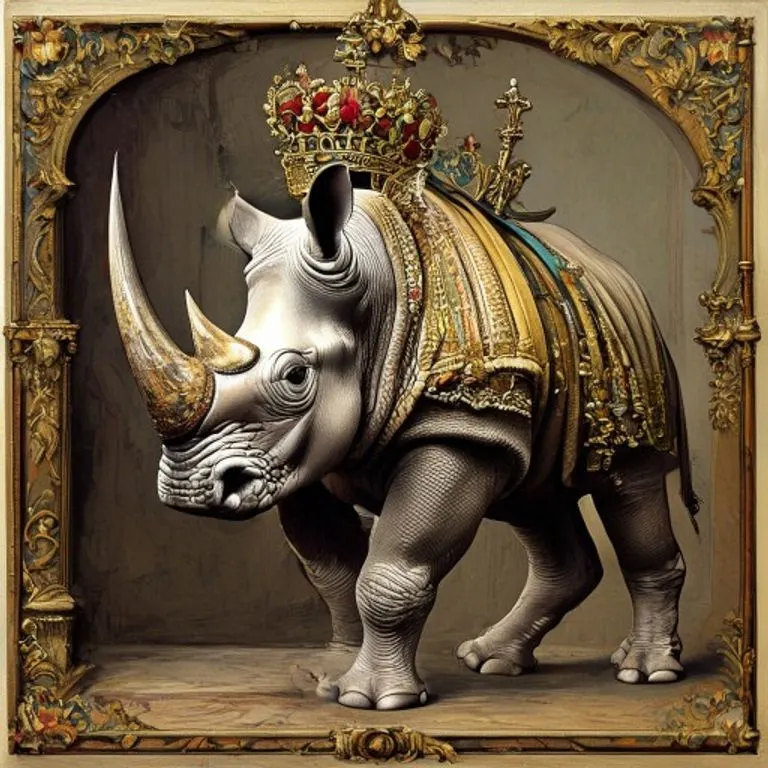
An artistic rendition of Abada, the Indian rhinoceros, as she might have appeared in a 16th-century European royal menagerie, a symbol of exotic power and natural wonder.
Abada's Arrival in Europe: From India to Portugal
Abada's journey to Europe began in India, likely as a diplomatic gift. She arrived at the bustling port of Lisbon around 1577, destined for the esteemed animal collection of King Sebastian I of Portugal. This was a period of intense maritime exploration and trade, with exotic animals frequently exchanged as tokens of power and alliances between distant rulers.
Upon her arrival, a practical, though perhaps unsettling, measure was taken: her horn was removed. This was likely a safety precaution, as rhinoceroses were formidable creatures, and handlers would have been wary of their immense power. Historical accounts suggest this removal may have been a regular practice, with the horn regrowing and being re-removed periodically, reflecting the challenges of managing such an animal in captivity.
Sebastian I's reign was tragically cut short in 1578, leading to a succession crisis. His successor, Henry, reigned for only two years. Following Henry's death in 1580, Philip II of Spain, a shrewd and ambitious monarch, asserted his claim to the Portuguese throne. This act led to the unification of the Spanish and Portuguese crowns, an event known as the Iberian Union, and with it, Philip II inherited all of Portugal's royal assets, including its prized menagerie and, most notably, Abada.
Philip II's Acquisition and the Royal Menageries
With the integration of Portugal into his vast empire, Philip II gained possession of Abada. The rhinoceros was subsequently moved to the royal menagerie located at the Casa de Campo, a sprawling estate just outside Madrid. This menagerie was a testament to Philip II's fascination with the natural world and his desire to showcase the exotic wonders of his global empire.
The Casa de Campo served as a temporary home before Abada was transferred again on October 16, 1583, to the newly established zoo within the grounds of El Escorial. El Escorial, a monumental complex comprising a palace, monastery, basilica, and library, was Philip II's ambitious vision—a center of power, faith, and knowledge. Housing an exotic animal like Abada there further solidified its status as a symbol of royal grandeur and intellectual curiosity.

An antique map illustrating the maritime routes and key locations involved in the rhinoceros's journey from Asia to Europe.
The transfer to El Escorial was not without incident, as recorded by contemporary accounts. One particular anecdote highlights the challenges of handling such a powerful animal. A keeper, perhaps misguidedly, attempted to "reload" Abada by spraying her with buckets of water. This sudden immersion startled the rhinoceros, causing her to panic and knock down her attendants. This incident underscores the inherent dangers and unpredictability of managing exotic wildlife in an era without modern animal husbandry practices.
Life at El Escorial: Public Spectacle and Royal Pranks
At El Escorial, Abada became a public spectacle, attracting considerable attention. She was put on display for visitors, including notable dignitaries. In November 1584, she was notably introduced to Japanese ambassadors, a moment that further emphasized the global connections of Philip II's empire and the exotic nature of his collection. These encounters were not just about entertainment; they were also opportunities for cultural exchange and the display of imperial power.
Juan Gonzalez de Mendoza, in his influential book "China" (published in 1585), mentions the public's impressions of Abada. He noted that people were particularly struck by her "thick fur" (a common misconception, as rhinoceros skin is tough and leathery, not furry) and her horn. There was also speculation among the populace as to whether Abada might be the legendary unicorn, a creature of myth and wonder that had captivated European imagination for centuries.
Philip II, despite his serious demeanor, was known to indulge in occasional mischievous acts. One such instance involved using his exotic animals to play pranks on the Jeronimos monks residing at El Escorial. In the autumn of 1584, he arranged for a newly acquired Indian elephant (also inherited from the Portuguese menagerie) to be driven down the monastery stairs and into the friars' cells, much to their surprise.
The following week, Philip II decided to repeat the trick with Abada. However, the rhinoceros proved to be far less cooperative than the elephant. While the elephant reportedly navigated the strange circumstances with relative ease, Abada was described as stubborn and complaining, growling grumpily and refusing to eat the food presented to her. This anecdote highlights her strong will and perhaps the stress she endured in such an unnatural environment.
Controversies and Abada's Mysterious Fate
The life of Abada was not without its darker aspects, reflecting the often-harsh realities of animal captivity in the past. One significant controversy surrounds the theory that, at some point during her captivity, Abada may have been blinded by her attendants. This drastic measure was purportedly taken to make her less likely to attack, as her handlers found her difficult to manage.
While this remains a theory, it paints a grim picture of the lengths to which people would go to control powerful wild animals, often at the expense of the animal's welfare. Such practices were unfortunately not uncommon in historical menageries, where understanding of animal behavior and ethical treatment was rudimentary at best.
A dramatic depiction of El Escorial, the grand complex where Abada resided, hinting at the solemn atmosphere of its monastery.
Abada's exact date of death is not definitively recorded, but it is generally believed she died by 1588. However, her image continued to circulate and influence artistic representations. Juan Villafane Arphe's decorating manual, published in 1585, included a description and print of a rhinoceros based on observations of Abada. Notably, this depiction lacked the dorsal horn that Dürer had added to his famous woodcut, suggesting a more accurate representation derived from direct viewing.
She was still alive in 1586 when her image was captured in an engraving by Philippe Galle, and Pedro Páez reportedly saw her in 1587. After this, there are no further records of her. Her disappearance from historical accounts marks the end of her life as a living spectacle, but not the end of her impact.
Abada's Lasting Legacy and Cultural Impact
Despite her relatively short life in Europe, Abada left an indelible mark on the cultural and historical landscape. Her presence provided a rare opportunity for Europeans to observe a rhinoceros firsthand, challenging and refining the popular image largely shaped by Dürer's imaginative, yet somewhat inaccurate, rendition. The direct observations of Abada contributed to a more accurate understanding of the species, even if these insights were slow to disseminate.
Perhaps one of the most enduring tributes to Abada is a street in Madrid, Calle de la Abada, near the iconic Puerta del Sol, which still bears her name. This urban landmark serves as a subtle, yet powerful, reminder of the rhinoceros's historical presence in the Spanish capital and her significance to the royal court. It connects the natural world, even an exotic one, to the very fabric of the city.
Her story also highlights the role of royal menageries in the early modern period. These collections were not just about entertainment; they were centers for scientific study (as much as was possible then), diplomatic gifts, and potent symbols of a monarch's wealth, power, and global reach. Abada was a living embodiment of Philip II's vast empire, stretching from the Americas to Asia.
The anecdotes surrounding her, from the water bucket incident to the prank on the monks, offer glimpses into the daily life and interactions within the royal court, humanizing the grand figures of history and the extraordinary creatures they kept. Abada's narrative is a microhistory that reflects broader themes of exploration, scientific curiosity, and the complex relationship between humans and the natural world.
Etymological Origins of the Name "Abada"
The name "Abada" itself carries a fascinating etymological history, distinct from its association with Philip II's rhinoceros. It is widely believed to be derived from the Malay word "badak," which is a general term for rhinoceros. This linguistic connection suggests that the name was likely introduced to the Iberian Peninsula through Portuguese traders and explorers who had extensive contact with Southeast Asia.
The use of "badak" as a generic term for rhinoceros in Malay-speaking regions would have naturally led to its adoption in Portuguese and Spanish contexts, particularly around 1530, when exotic goods and animals from the East began to flow into Europe more regularly. As Abada was, for a time, the only rhinoceros in Europe, the generic term quickly morphed into her specific proper name, a common linguistic phenomenon when a unique specimen represents an entire category.
This etymological root underscores the global nature of the 16th century, where words, goods, and animals traveled across continents, enriching European languages and cultures. The adoption of "Abada" from Malay into European usage is a linguistic artifact of the Age of Exploration, reflecting the interconnectedness of distant lands.
Understanding this origin helps to contextualize why the name might appear in other, seemingly unrelated, cultural contexts, as the word itself became part of a broader lexicon, albeit with varied interpretations and applications.
Beyond the Rhinoceros: Other Meanings of "Abada"
While the historical rhinoceros is the most prominent association with the name Abada, the term also appears in various other cultural, mythological, and even martial arts contexts. These diverse meanings highlight the polysemic nature of language and how a single word can acquire different significances across distinct domains.
In mythology and folklore, "Abada" takes on mystical connotations:
- Tatar Mythology: Abada is described as an innocent forest spirit, often appearing as an old woman. This benevolent figure is part of the rich tapestry of Tatar folklore, representing a connection to nature and ancient traditions.
- African Mythology: In some African traditions, Abada refers to a type of small, timid unicorn found in the Congo region. This creature is rarely seen, emphasizing its elusive and mystical nature. It adds to the global fascination with unicorn-like beings, distinct from the European archetype.
- Siberian Peoples: The term "Abada" is also represented in the mythologies of various Siberian peoples, further illustrating its widespread presence in different folkloric narratives, often associated with spirits or unique animals.
Beyond the realm of myth, "Abada" also has practical applications in martial arts:
- Abadá-Capoeira: This is a prominent nonprofit organization dedicated to promoting and supporting Brazilian culture through the practice of Capoeira. The organization's name incorporates "Abadá," signifying its identity and mission.
- Abadá (Capoeira Pants): Within Capoeira, an "abadá" also refers to the specific type of pants worn by capoeiristas (practitioners of Capoeira). These white, loose-fitting pants are an integral part of the Capoeira uniform and tradition.
Finally, "Abada" can also be found as a surname, particularly of French origin. This usage, while distinct from the other meanings, demonstrates the word's integration into personal identities and genealogical histories. The multiplicity of meanings for "Abada" underscores its journey through history, language, and culture, transforming from a generic animal term into a multifaceted concept.
Conclusion: A Name Etched in History and Culture
The story of Abada, the Indian rhinoceros of Philip II, is a captivating chapter in the history of European natural history and royal courts. Her journey from India to Lisbon and then to the grand menageries of Madrid and El Escorial symbolizes the era's global interconnectedness and the fascination with exotic wonders. She was more than just an animal; she was a diplomatic gift, a scientific curiosity, a public spectacle, and a symbol of imperial power.
Her legacy endures not only in historical records and artistic representations but also in the very streets of Madrid, a testament to her unique place in Spanish history. Furthermore, the name "Abada" itself, with its roots in the Malay word for rhinoceros, has transcended its original meaning to encompass a diverse array of cultural references, from Tatar forest spirits and African unicorns to the martial arts of Capoeira and even a French surname.
This rich tapestry of meanings demonstrates how a single term can weave its way through different cultures and disciplines, acquiring new layers of significance while retaining a connection to its historical and linguistic origins. Abada, in all its forms, remains a fascinating subject, inviting us to explore the intersections of history, language, mythology, and human-animal interaction.
Fuente: Contenido híbrido asistido por IAs y supervisión editorial humana.


Comentarios