
Music Neuroscience: Brain Learning Emotion Power
Music, an ancient and universal human phenomenon, transcends mere entertainment to profoundly influence our cognitive and emotional landscapes. Modern neuroscience has begun to unravel the intricate mechanisms through which the brain processes, interprets, and responds to musical stimuli. This exploration reveals not only the complexity of auditory processing but also how music can serve as a powerful tool for learning, memory enhancement, emotional regulation, and even therapeutic intervention. Understanding these neural underpinnings provides a deeper appreciation for music's pervasive role in human experience and development.
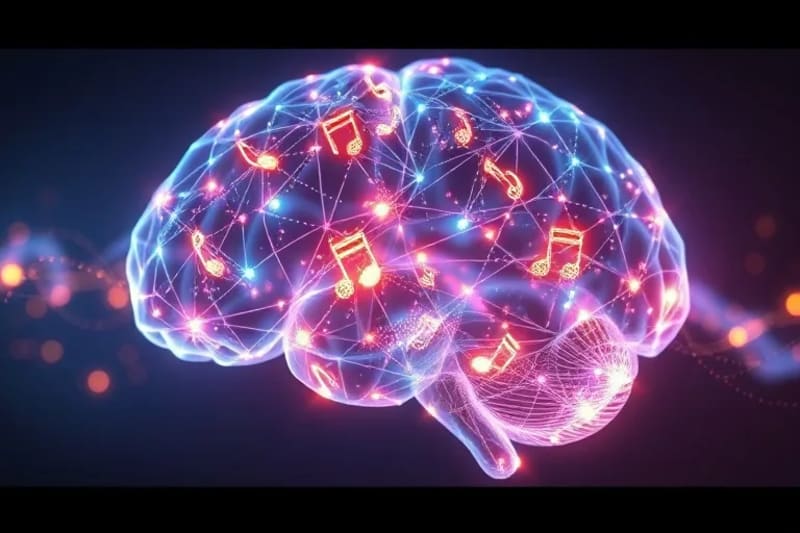 Abstract neural pathways and musical notes intertwining within a translucent, glowing brain silhouette, symbolizing music's profound impact on cognitive and emotional processing.
Fuente visual sujeta a disponibilidad del ecosistema: Wikimedia Commons bajo licencia CC BY-SA 4.0 o renderizado conceptual IA.
Table of Contents
- The Brain's Auditory Processing of Music
- Emotion and Music: A Deep Connection
- Music, Learning, and Memory Enhancement
- Neuroplasticity and Musical Training
- Therapeutic Applications of Music Neuroscience
- Future Directions in Music Neuroscience Research
The Brain's Auditory Processing of Music
When we listen to music, our brains engage in an extraordinarily complex process, far beyond simple sound perception. The journey begins in the auditory cortex, located in the temporal lobe, where basic features like pitch, timbre, and rhythm are first analyzed. However, music processing quickly extends to a vast network of brain regions, including those involved in emotion, memory, motor control, and even language. This distributed processing highlights music's multifaceted nature and its ability to activate diverse cognitive functions simultaneously.
Different elements of music are handled by specialized, yet interconnected, brain areas. For instance, rhythm and beat perception often involve motor areas, even when no physical movement occurs, suggesting an inherent link between music and movement. Pitch processing relies heavily on the primary auditory cortex, while harmony and melodic contour engage higher-order auditory regions. The brain's ability to extract patterns and anticipate upcoming notes is crucial for musical enjoyment and understanding, demonstrating sophisticated predictive coding mechanisms at play.
Emotion and Music: A Deep Connection
One of music's most striking powers is its capacity to evoke strong emotions. This emotional resonance is not merely subjective; it is rooted in specific neural circuits. Research indicates that listening to music can activate the brain's reward system, releasing dopamine, a neurotransmitter associated with pleasure and motivation. This explains why music can be so intrinsically gratifying and why certain pieces can induce feelings of euphoria, sadness, or excitement.
The amygdala, a key region for processing emotions, and the hippocampus, vital for memory formation, are highly active during musical experiences. This interplay explains why a particular song can instantly transport us back to a specific moment or evoke powerful nostalgic feelings. The emotional impact of music is also culturally influenced, with different cultures associating varying emotional meanings with specific musical modes, scales, or rhythmic patterns. This deep connection between music and emotion underscores its potential for therapeutic applications, such as in mood regulation and stress reduction.
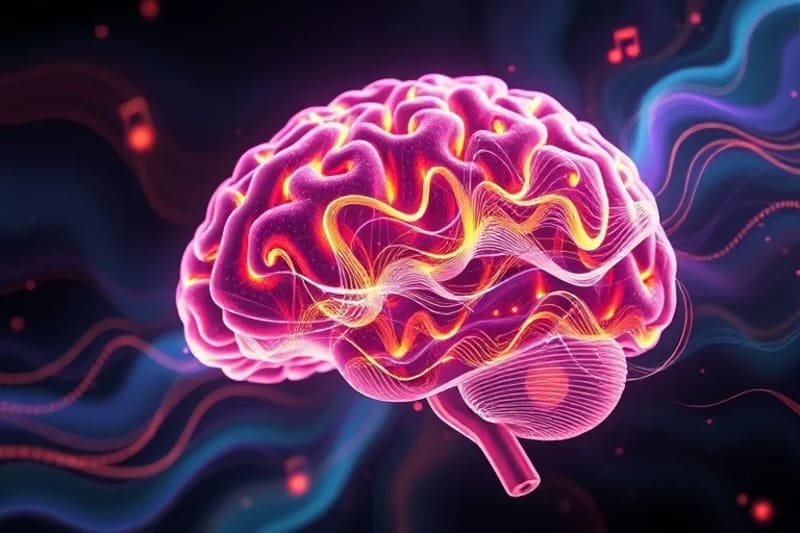 A dynamic, abstract visualization of sound waves transforming into intricate patterns within a brain-like structure, highlighting the emotional impact and processing of music.
Music, Learning, and Memory Enhancement
The cognitive benefits of music extend significantly to learning and memory. Studies have shown that musical training can enhance various cognitive abilities, including language acquisition, spatial-temporal reasoning, and mathematical skills. This is partly due to the fact that music engages multiple brain areas simultaneously, strengthening neural connections and promoting overall cognitive flexibility. For instance, the rhythmic and structural elements of music can aid in developing phonological awareness, a critical component of reading readiness.
Music also serves as a potent mnemonic device. Information presented with a musical accompaniment or set to a melody is often recalled more easily and accurately than information presented without it. This "musical memory" effect is particularly evident in early childhood education, where songs are frequently used to teach the alphabet, numbers, and other foundational concepts. The brain's capacity for complex thought and memory is a fascinating area of study, much like the scientific persistence seen in figures such as Marie Curie's contributions to modern physics.
Furthermore, music can influence our ability to focus and sustain attention. Background music, depending on its complexity and familiarity, can either enhance or detract from cognitive tasks. Instrumental music, especially classical or ambient genres, is often used to improve concentration during work or study. The brain's ability to process and integrate musical information while simultaneously performing other tasks underscores its remarkable adaptability and efficiency. This ability to maintain focus and achieve peak performance is also a key aspect of the psychology of the winner in high-performance sports.
Neuroplasticity and Musical Training
One of the most profound insights from music neuroscience is its demonstration of neuroplasticity – the brain's ability to reorganize itself by forming new neural connections throughout life. Extensive musical training, particularly starting at a young age, leads to significant structural and functional changes in the brain. Musicians often exhibit larger gray matter volume in auditory and motor cortices, enhanced connectivity between brain hemispheres, and more efficient neural processing of auditory information.
These changes are not limited to music-specific skills. Musicians tend to have superior auditory memory, improved executive functions (such as planning and problem-solving), and enhanced fine motor skills. The discipline required for musical practice, including sustained attention, error detection, and continuous self-correction, provides a rigorous workout for the brain, fostering a wide array of cognitive benefits. This constant engagement and adaptation are also relevant to understanding diverse cognitive processing, such as the Chinese Zodiac leadership archetypes and corporate dynamics, which require complex interpretation and application.
 An extreme close-up of a vintage piano key with subtle, glowing neural network patterns superimposed, illustrating the intricate connection between music and brain activity.
Therapeutic Applications of Music Neuroscience
The deep understanding of how music affects the brain has paved the way for numerous therapeutic applications. Music therapy is now a recognized and effective intervention for a wide range of conditions. For individuals with neurological disorders such as stroke, Parkinson's disease, or traumatic brain injury, rhythmic auditory stimulation can help improve motor function, gait, and speech. The predictable patterns in music can act as external cues, helping to re-establish neural pathways affected by damage.
In mental health, music therapy is used to alleviate symptoms of anxiety, depression, and PTSD. The emotional regulation capabilities of music, coupled with its ability to reduce stress hormones, make it a valuable tool for promoting psychological well-being. For example, listening to calming music can lower heart rate and blood pressure, inducing a state of relaxation. This aligns with principles of positive psychology, where engagement and well-being are key, similar to strategies explored in positive psychology in the workplace.
Music also plays a crucial role in pain management, particularly in chronic pain conditions. By diverting attention, promoting relaxation, and activating the brain's endogenous opioid system, music can reduce the perception of pain. For patients undergoing medical procedures or recovering from surgery, music can decrease the need for pain medication and improve overall comfort. Its non-invasive nature and broad appeal make it an accessible and patient-friendly therapeutic modality.
Future Directions in Music Neuroscience Research
The field of music neuroscience is continuously evolving, with exciting new avenues of research emerging. Future studies are likely to delve deeper into the genetic and epigenetic factors that influence musical ability and perception. Advanced neuroimaging techniques will provide even more detailed insights into the real-time neural dynamics of musical engagement, potentially revealing individual differences in brain responses to music.
Another promising area is the development of personalized music interventions. By understanding how specific musical parameters (e.g., tempo, timbre, melodic complexity) affect individual brains, tailored music therapy programs could be designed for optimal therapeutic outcomes. Research into the effects of music on neurodegenerative diseases, such as Alzheimer's and dementia, also holds significant promise for improving quality of life and cognitive function in aging populations. The interdisciplinary nature of this field, combining neuroscience, psychology, musicology, and technology, ensures a rich future for discovery and application.
In conclusion, music is far more than just sound; it is a fundamental aspect of human cognition and emotion, deeply embedded in our neural architecture. From shaping our learning abilities to regulating our moods and aiding in recovery, the power of music continues to astonish scientists and enrich lives. As neuroscience advances, our understanding of this ancient art form will only deepen, unlocking new possibilities for health, education, and human flourishing.
Source: Hybrid content assisted by AI and human editorial supervision.


Comentarios