
Augmented Reality Robotic Surgery: Precision, Safety | Althox
The convergence of Augmented Reality (AR) and robotic surgery represents a monumental leap forward in medical technology. This synergy is not merely an incremental improvement but a transformative force, reshaping the landscape of surgical procedures. By integrating digital information with the physical world, AR empowers surgeons with unprecedented levels of precision, enhanced visualization, and critical real-time data during complex operations. This article delves into the intricate ways AR is enhancing robotic surgery, focusing on its impact on procedural accuracy and patient safety, and exploring the underlying technologies driving this revolution.
Robotic-assisted surgery has already revolutionized many medical fields by offering superior dexterity, tremor reduction, and improved access to hard-to-reach anatomical areas. However, the addition of Augmented Reality layers a new dimension of capability onto these systems. Surgeons can now visualize critical pre-operative imaging, such as CT scans or MRIs, directly overlaid onto the patient's anatomy in real-time, or within their field of view via specialized headsets or monitors. This creates a "super-vision" that transcends the limitations of human perception, leading to more informed decisions and meticulous execution.

A surgeon expertly controls a robotic system, guided by an augmented reality overlay that projects vital anatomical data directly onto the surgical field, enhancing precision and safety in modern medical procedures.
Table of Contents
- Enhancing Precision Through Advanced Visualization
- Boosting Patient Safety with Real-Time Data Integration
- Key Technologies Powering AR in Robotic Surgery
- Diverse Applications Across Surgical Fields
- Comprehensive Benefits for Surgeons and Patients
- Current Challenges and the Future Outlook
Enhancing Precision Through Advanced Visualization
One of the most significant contributions of AR to robotic surgery is its ability to provide unparalleled visual guidance. Traditional surgery relies heavily on a surgeon's experience, anatomical knowledge, and interpretation of 2D images. Robotic systems offer a magnified 3D view, but AR takes this a step further by layering dynamic, interactive 3D models directly onto the live surgical feed.
This augmented view allows surgeons to see structures that are otherwise obscured, such as tumors hidden beneath tissue layers or the precise trajectories of nerves and blood vessels. For instance, in neurosurgery, AR can project a patient's brain tumor boundaries, derived from pre-operative MRI scans, onto the live surgical view, enabling surgeons to resect with millimeter-level accuracy while preserving healthy tissue. This level of detail minimizes the risk of collateral damage and improves functional outcomes for patients.
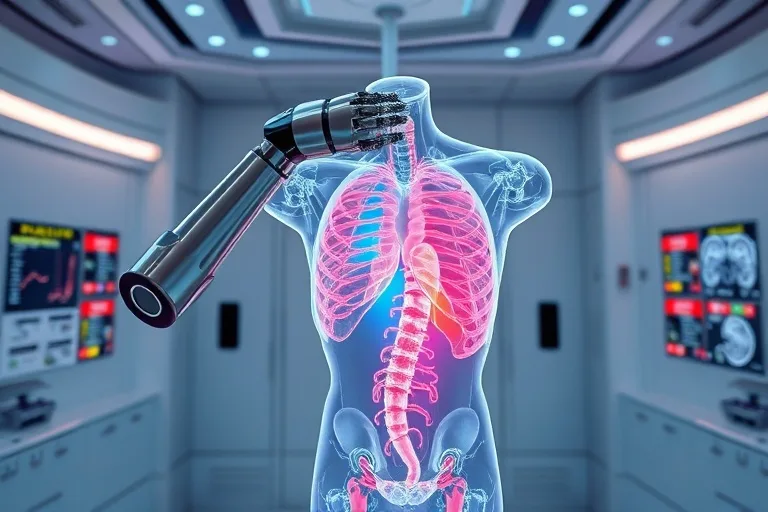
A sophisticated robotic surgical arm demonstrates enhanced capabilities with digital overlays, providing surgeons with a detailed, real-time view of anatomical structures for superior precision.
The capability to fuse multi-modal imaging data—such as CT, MRI, and ultrasound—into a single, coherent augmented reality display is transformative. This fusion provides a comprehensive understanding of the surgical site, allowing for better planning and execution. Surgeons can toggle between different data layers, zoom in on specific areas, and even simulate surgical steps before making an incision. This pre-visualization and intra-operative guidance significantly reduce uncertainties, especially in anatomically complex regions or during revision surgeries.
Furthermore, AR can highlight critical zones, such as areas of high vascularity or proximity to vital organs, with color-coding or virtual boundaries. This visual cueing acts as an additional safety net, guiding the surgeon's hands and the robotic instruments away from delicate structures. The integration of haptic feedback systems with AR can even provide tactile sensations, alerting surgeons to the presence of boundaries or changes in tissue density, further refining their control and precision.
Boosting Patient Safety with Real-Time Data Integration
Beyond enhanced visualization, AR significantly improves patient safety by integrating real-time physiological and procedural data directly into the surgical field. This immediate access to critical information allows surgeons to react proactively to changes and mitigate potential risks during the operation. Imagine a scenario where a surgeon is performing a cardiac procedure, and AR overlays display the patient's real-time heart rate, blood pressure, and oxygen saturation levels, alongside the anatomical structures.
This constant stream of data, presented intuitively within the surgeon's line of sight, eliminates the need to divert attention to separate monitors, reducing cognitive load and potential for error. AR systems can also track the position of surgical instruments with high accuracy, displaying their exact location relative to critical anatomical landmarks. This "GPS for surgery" prevents accidental punctures or incisions into unintended areas, a common concern in minimally invasive procedures where direct visualization is limited.

Abstract data streams and holographic projections intricately surround a brain model, illustrating the power of extended reality in medical diagnostics and real-time surgical guidance.
Moreover, AR can be programmed to issue alerts or warnings if instruments approach predefined "no-go" zones or if physiological parameters deviate from safe thresholds. This intelligent assistance acts as an extra layer of vigilance, particularly valuable during long or highly complex surgeries where fatigue could become a factor. The ability to monitor and react to such data in real-time significantly reduces intra-operative complications and improves overall patient outcomes.
The integration of artificial intelligence (AI) with AR and robotic systems further amplifies safety. AI algorithms can analyze vast amounts of surgical data, learn from past procedures, and provide predictive insights or suggest optimal pathways. When combined with AR, these AI-driven recommendations can be displayed directly to the surgeon, offering intelligent guidance that is constantly refined and improved. This symbiotic relationship between human expertise, robotic precision, AR visualization, and AI intelligence creates an unprecedented level of safety in the operating room.
Key Technologies Powering AR in Robotic Surgery
The sophisticated capabilities of AR in robotic surgery are underpinned by several advanced technologies working in concert. Understanding these components is crucial to appreciating the full scope of this innovation.
- High-Resolution Displays and Headsets: Surgeons interact with AR through specialized displays, often in the form of head-mounted devices (HMDs) or high-resolution monitors integrated into the robotic console. These devices must offer crisp, low-latency visuals to ensure seamless integration with the surgeon's natural vision and movements.
- Advanced Tracking Systems: Precise tracking of the patient's anatomy, surgical instruments, and the surgeon's head/eye movements is paramount. Technologies like optical tracking (using markers), electromagnetic tracking, and inertial measurement units (IMUs) are employed to maintain accurate registration between the virtual overlays and the real world, even with patient movement.
- Image Fusion and Registration Software: This software is the brain of the AR system, responsible for taking pre-operative imaging data (CT, MRI, ultrasound) and accurately aligning it with the live video feed from the surgical camera. Complex algorithms perform 3D reconstruction and real-time registration, ensuring that the virtual overlay perfectly matches the patient's actual anatomy.
- Low-Latency Computing and Graphics Processing: To provide a smooth, real-time augmented experience, the system requires powerful computing resources. High-performance graphics processing units (GPUs) are essential for rendering complex 3D models and overlays without noticeable delay, which could be detrimental in a surgical setting.
- Intuitive User Interfaces (UI) and User Experience (UX): The AR interface must be intuitive and non-distracting, allowing surgeons to access information and control features without breaking concentration. Voice commands, gesture control, and customizable displays are common features designed to optimize the surgical workflow.
These technologies are continuously evolving, becoming more compact, powerful, and accurate. The ongoing advancements promise even more immersive and effective AR solutions for future surgical applications.
Diverse Applications Across Surgical Fields
The versatility of AR in robotic surgery means its applications span a wide range of medical specialties, each benefiting from enhanced precision and safety.
| Surgical Field | Key AR Enhancement | Impact on Precision/Safety |
|---|---|---|
| Neurosurgery | Tumor localization, trajectory guidance for biopsies, preservation of critical brain structures. | Minimizes damage to healthy brain tissue, improves resection completeness, reduces neurological deficits. |
| Orthopedics | Precise implant placement (e.g., knee/hip replacements), bone fracture reduction, spinal fusion guidance. | Optimizes implant alignment, reduces revision rates, enhances stability and patient mobility. |
| General Surgery | Visualization of hidden vasculature, tumor margins in abdominal organs, lymph node dissection. | Reduces blood loss, ensures complete tumor removal, lowers risk of organ damage. |
| Urology | Prostatectomy, partial nephrectomy with precise tumor excision and nerve sparing. | Preserves urinary and sexual function, improves cancer control. |
| Cardiothoracic Surgery | Guidance for coronary artery bypass, valve repair, and complex tumor resections. | Enhances visualization in a constantly moving environment, reduces risk to vital cardiac structures. |
In each of these fields, AR provides a layer of intelligence and visual clarity that was previously unattainable. It transforms the surgical experience from a purely manual skill to a technologically augmented art form, where human expertise is amplified by digital precision.
Comprehensive Benefits for Surgeons and Patients
The adoption of AR in robotic surgery yields a multitude of benefits that extend to both the surgical team and, most importantly, the patients.
For surgeons, the advantages include:
- Reduced Cognitive Load: By presenting all necessary information within a single, integrated view, surgeons spend less time looking away from the patient or robotic console, allowing for greater focus.
- Enhanced Decision-Making: Real-time data and advanced visualization provide a more complete picture, enabling more confident and accurate decisions during critical moments.
- Improved Training: AR can be used in surgical simulators, offering realistic training environments where residents can practice complex procedures with virtual overlays and receive immediate feedback, accelerating skill acquisition.
- Reduced Fatigue: Optimized ergonomics and streamlined information flow can contribute to less physical and mental strain during lengthy operations.
For patients, the benefits are even more profound:
- Increased Safety: Lower rates of complications, reduced risk of unintended injury, and fewer errors due to enhanced precision and real-time monitoring.
- Better Outcomes: More complete resections of diseased tissue, better functional preservation, and improved long-term results, particularly in oncology and reconstructive surgeries.
- Faster Recovery: Minimally invasive procedures guided by AR often lead to smaller incisions, less pain, shorter hospital stays, and quicker return to normal activities.
- Reduced Need for Revision Surgeries: The accuracy afforded by AR can decrease the likelihood of needing follow-up operations due to incomplete initial procedures or complications.
The cumulative effect of these benefits is a healthcare system that is more efficient, safer, and ultimately, more effective in delivering high-quality patient care.
Current Challenges and the Future Outlook
Despite its immense promise, the widespread adoption of AR in robotic surgery faces several challenges. These include the high cost of initial investment in advanced AR hardware and software, the need for extensive training for surgical teams, and the complexities of regulatory approval for new medical devices. Furthermore, maintaining perfect registration between virtual overlays and dynamic anatomy during surgery, especially with patient breathing or organ movement, remains a technical hurdle that requires continuous innovation.
Data privacy and cybersecurity are also growing concerns, as these systems handle sensitive patient information and are connected to hospital networks. Robust security protocols are essential to prevent unauthorized access or manipulation of surgical data. However, ongoing research and development are actively addressing these issues.
The future of AR in robotic surgery is exceptionally bright. We can anticipate more compact and comfortable AR headsets, even more accurate tracking systems, and seamless integration with AI for predictive analytics and autonomous assistance in certain surgical tasks. The development of "digital twins" of patients, where a virtual replica of the patient's anatomy and physiology can be used for pre-operative planning and intra-operative guidance, is also on the horizon. As these technologies mature, AR will undoubtedly become an indispensable tool in every operating room, further solidifying its role in enhancing surgical precision and patient safety.
Fuente: Contenido híbrido asistido por IAs y supervisión editorial humana.


Comentarios