
Maritime Law: Spanish Commercial Code Navigation Risks | Althox
Maritime trade, a cornerstone of global commerce for centuries, is inherently fraught with risks. From unpredictable weather to human error, the journey across the seas presents numerous challenges that can result in significant financial losses and legal disputes. To address these complexities, legal frameworks have been developed over time, providing clarity and mechanisms for managing such risks.
The Spanish Commercial Code, specifically Book III, Title VI, stands as a crucial legislative instrument governing "Risk Navigation." This section meticulously defines various types of damages, establishes protocols for their assessment and distribution, and outlines procedures for events like collisions and forced landings. Understanding these regulations is paramount for shipowners, carriers, insurers, and all stakeholders involved in maritime expeditions.
This comprehensive guide delves into the intricacies of the Spanish Commercial Code's provisions on maritime risks, offering a detailed analysis of its articles. We will explore the distinctions between different types of average, the rigorous process of declaring and challenging general average, the legal implications of ship collisions, and the specific rules surrounding forced landings. Our aim is to provide a clear and authoritative overview of this vital area of maritime law, shedding light on its practical applications and significance in modern shipping.
Table of Contents
- Definitions and General Rules
- Simple or Particular Average
- General or Common Average
- Collision (Abordaje)
- Forced Landing (Arribada Forzosa)

An ancient maritime chart symbolizes the historical origins and enduring complexities of shipping law and navigation risks.
Definitions and General Rules
The Spanish Commercial Code begins by establishing fundamental definitions and general rules that underpin the entire Title VI. These initial articles are crucial for understanding what constitutes "damage" in a maritime context and how different types of expenses are categorized.
Section 1087. For purposes of this title shall mean damage:
1. Any damage suffered by the ship, whether or not charged, in port or while browsing, and affecting the load since it is loaded at the place of issue, until landing in the consignment, and
2. All unforeseen extraordinary expenses incurred during the expedition to the preservation of the ship, cargo or both at once.
Section 1088. Breakdowns are not ordinary expenses arising from:
1. pilotage and pilotage;
2. boats and trailers;
3. Harbour dues or other services to shipping;
4. Loading and unloading of goods, and
5. In general, all ordinary navigation.
Section 1089. All charges referred to in the preceding Article shall be borne by the carrier and or ship owner, unless other rules in this book or the agreement of the parties provide otherwise.
Section 1090. The faults are classified as:
1. Simple or individuals, or
2. Thick or common.
In both cases it may be cost breakdowns and failures of damage.
Section 1091. In the absence of express provision, the liquidation and payment of damages shall be governed by the provisions of this title.
Section 1092. The arrangement of the damage done outside the territory of the Republic shall be governed by the law and customs of the place where such settlement check.
According to Section 1087, "damage" (avería) encompasses two main categories. First, it refers to any harm sustained by the vessel, whether laden or not, while in port or navigating, impacting the cargo from loading to landing. Second, it includes all unforeseen extraordinary expenses incurred during the voyage for the preservation of the ship, cargo, or both.
It is crucial to differentiate these damages from "ordinary expenses," as outlined in Section 1088. Ordinary expenses, such as pilotage, towing, harbor dues, and loading/unloading costs, are considered part of the normal course of navigation. These routine charges, as per Section 1089, are typically borne by the carrier or shipowner, unless specific agreements or other rules in the Code dictate otherwise. This distinction is vital for determining liability and insurance claims.
Section 1090 introduces the classification of damages into two primary types: "simple or particular" and "thick or common" (general average). Both categories can involve either the cost of repairs or the value of the damage itself. The Code further specifies that, in the absence of explicit provisions, the liquidation and payment of these damages will adhere to the rules set forth in this title (Section 1091).
An important jurisdictional aspect is covered in Section 1092, which states that damages incurred outside the Republic's territory will be governed by the laws and customs of the place where the settlement occurs. This highlights the international nature of maritime law and the potential for different legal frameworks to apply depending on the incident's location and the settlement venue.
Simple or Particular Average
Simple or particular average refers to damages or expenses that affect only a specific interest, such as the ship or a particular part of the cargo, rather than all interests involved in the maritime expedition. This type of average is distinct because the loss is not shared among all parties.
Section 1093. Faults are single or individuals:
1. The loss or damage affecting the ship or cargo, force majeure, inherent vice or by acts or events of the shipper, shipping, dependents or others;
2. The expenses incurred unforeseen extraordinary exclusive benefit of the ship, cargo or part thereof, and
3. In general, all damages and unforeseen extraordinary expenses that do not deserve the qualification of general average.
Section 1094. The owner of the thing that had suffered damage or expense caused, will support the particular fault, without prejudice to its right to pursue the corresponding responsibilities.
Section 1093 provides a clear definition of what constitutes simple or particular average. These include losses or damages to the ship or cargo resulting from force majeure, inherent vice, or actions of the shipper, shipping company, their dependents, or other parties. It also covers unforeseen extraordinary expenses incurred exclusively for the benefit of the ship, a specific part of the cargo, or the entire cargo.
Essentially, any damage or extraordinary expense that does not meet the criteria for general average falls under this category. The key characteristic is the localized nature of the loss or expense. For instance, if a specific consignment of goods is damaged due to improper packaging (inherent vice) or if the ship sustains damage from an unexpected storm that only affects the vessel itself without requiring a sacrifice for the common safety of the entire adventure, these would be considered particular average.
Section 1094 clarifies the responsibility for particular average: the owner of the property that suffered the damage or incurred the expense is the one who bears the particular average. This is a fundamental principle, as it places the burden directly on the affected party. However, this does not preclude their right to pursue claims against other responsible parties if the damage was caused by their actions or negligence. This provision ensures that while the immediate burden falls on the owner, avenues for recourse remain open.
General or Common Average
General average is one of the most complex and historically significant concepts in maritime law. It represents a collective sacrifice or expense intentionally and reasonably made to preserve all interests involved in a maritime expedition from a common peril. Unlike particular average, the costs of general average are shared proportionally among all parties whose interests were saved.
Section 1095. They are average or common sacrifices or unforeseen extraordinary expenses, incurred or made intentionally and reasonably in order to preserve a common danger to the interests involved in the maritime expedition.
The core definition in Section 1095 highlights several critical elements: the sacrifice or expense must be unforeseen, extraordinary, intentional, and reasonable. Most importantly, it must be undertaken to preserve interests from a "common danger." This means the peril must threaten the entire maritime adventure—the ship, its cargo, and the freight—and the action taken must be for the benefit of all.
Admission and Declaration of General Average
The process of admitting and declaring a general average is highly regulated, reflecting its significant financial implications for all parties. The Code provides detailed guidelines for how these events are to be handled, from the captain's initial decision to the final settlement.
Section 1096. The classification, liquidation and distribution of general average, the parties may agree to use any kind of standards, which have received legal sanction of a state, whether from applications or agreements, foreign or international public or private or rules of practice, national or foreign.
Section 1097. The decision to take measures average or common, rests solely with the captain of the ship or his substitute, which in the circumstances of the case, hear the views of representatives of the load, if they are present.
Section 1098. Adopted the decision giving rise to the common fault and as soon as circumstances permit, the master shall record it in the log book, which will contain the date, time and place of the event, the measures ordered by the captain and fundamentals. In the first place of arrival, and as soon as possible, the master shall confirm the facts relating to the general average, in the Book blog, before a minister of faith, without prejudice to information corresponding to the maritime authority, if regardless Chilean port. When the arrival abroad should occur and the fault hath consequences in Chile, the ratification must be made to the Chilean consul, and failing that, before a minister of faith or to the competent local court.
Section 1099. Applies only to general average damages, losses or expenses arising from the act that originates. However, this effect will be included as expenses and liquidation of the damage and interest values for losses and disbursements payable in general average. Damage or loss caused to delay the ship or cargo, either during or after the trip, and indirect losses due to this same cause, such as demurrage resulting from market and difference will not be admitted average.
Section 1100. Any expenses incurred to avoid loss, damage or expenditure that would have been payable in general average shall also be admitted as such, only to crowd the value of the damage or loss avoided or saved costs, as appropriate.
Section 1101. The burden of proving that an injury or expense should be admitted in general average, is in charge of who calls.
Section 1102. Faults are thick over the ship, freight and goods that exist in it at the time of those occur. Contribution shall be paid in proportion to the value of such goods.
Section 1103. There shall be a settlement of the general average, but the incident which has caused the damage or expense is due to the fault of one of the stakeholders in the maritime expedition, without prejudice to any action or defenses that THEY MAY exercise against.
Section 1104. The common fault is cleared, both in terms of losses and contributions, based on the values of the interests involved, the date and place where the sea expedition ends.
Section 1105. The arrangement of the general average shall be made by an expert liquidator. Declared general average, if not already agreed in advance the name of the liquidator, or is not reached agreement on a person to designate, either party may request the appointment to judge the port where it finishes. Required the court for the appointment, if the port was Chilean, it shall arrange his appointment in the manner prescribed by Articles 414 and 415 of the Code of Civil Procedure, without further ado. If the appointment is made in Chile, it shall devolve upon a Chilean insurance adjuster who has been appointed in the manner prescribed by law.
Parties can agree on various standards for the classification, liquidation, and distribution of general average, including national, foreign, or international rules of practice (Section 1096). This flexibility allows for the adoption of widely recognized standards, such as the York-Antwerp Rules, which provide a common framework for general average adjustments globally.
The captain holds the sole authority to decide on general average measures (Section 1097), though they should consult with cargo representatives if present. This emphasizes the captain's critical role as the ultimate decision-maker in moments of peril. Following such a decision, the captain must meticulously record the event in the log book, detailing the date, time, location, measures taken, and their justifications (Section 1098). This documentation is essential for subsequent legal and insurance processes.
Upon arrival at the first port, the captain must confirm the facts before a minister of faith (e.g., a notary) or a Chilean consul if abroad, especially if the average has consequences in Chile. This formal ratification process ensures the authenticity and legal validity of the general average declaration.
Section 1099 clarifies what can and cannot be included in general average. Only damages, losses, or expenses directly arising from the general average act are admitted. Crucially, damages or losses caused by delays, such as demurrage or market differences, are explicitly excluded. However, expenses incurred to avoid a general average loss that would have been admitted are themselves admitted, up to the value of the loss avoided (Section 1100).
The burden of proof for admitting an injury or expense into general average rests with the party claiming it (Section 1101). General average applies to the ship, freight, and goods existing at the time of the incident, with contributions paid proportionally to their value (Section 1102). A general average settlement will not occur if the incident was due to the fault of one of the stakeholders, though this does not prejudice their right to pursue actions against the responsible party (Section 1103).
The liquidation of general average is based on the values of the interests involved at the date and place where the maritime expedition concludes (Section 1104). An expert liquidator is responsible for arranging the general average. If no liquidator is pre-agreed or chosen by mutual consent, any party can request the appointment from the judge of the port where the voyage ends (Section 1105). In Chile, this appointment follows specific articles of the Code of Civil Procedure and is typically assigned to a legally appointed Chilean insurance adjuster.

The principle of general average dictates the proportional sharing of losses to preserve the entire maritime expedition.
Procedure to Declare and Challenge General Average
Beyond the initial declaration, the Code also outlines procedures for situations where a general average is not declared by the master or owner, or when its legitimacy is challenged by an interested party. These mechanisms ensure fairness and recourse for all involved.
Section 1106. When the master or owner of the vessel concerned has not declared a general average, anyone interested in it, may ask the judge indicated in the previous article to appoint an arbitrator to rule on the existence of the general average, unless already had been appointed. This request may be made within six months following the expiration of the download. The appointment, failing agreement will stick to the rules of paragraph 1 of Part VIII of this Book. In turn, if declared general average by the master or owner of the ship, any interested party wishes to object in issuing its legitimacy, must make his appeal to the same judge indicated in the preceding article, within sixty consecutive days, counted since it has received notice in writing of the declaration of general average, or since has signed a commitment to malfunction, is not received before that communication. The parties may also directly initiate an arbitration procedure. Written expression includes, inter alia, telegram and telex. It may be objected then the legitimacy of the fault, which is subject to action granted by section 1111 to object to the settlement itself.
Section 1107. Posed a challenge by an interested party, the court shall summon the parties to a subpoena to appoint an arbitrator to hearing the trial of impeachment. Be parties to this effect, the appellant, the owner of the vessel affected and who has applied for a declaration of general average.
Section 1108. The trial to declare a general average, as of the promotion to challenge its legitimacy, the referee will know in a single instance, and will also be invested with the powers specified in Article 1206 of this Book. Unless the parties agree otherwise handling in these trials will comply to the Code of Civil Procedure provides for summary proceedings, with the exception of Articles 681 and 689.
Section 1109. All requests to declare the failure or challenge to their legitimacy, are processed jointly in a single trial. For this purpose, all claims will accrue to the first one is formulated and will be competent court or the arbitrator appointed to be appointed at the trial that first promoted there. Other stakeholders who have not deducted challenges in a timely manner may be made party to the lawsuit stated, provided they do so before the hearing, answering established in summary proceedings, and from that moment they will also all other paperwork litigation. The sentence that falls in the trial of impeachment, only affect those who have been party to it. If the sentence or acogiere the challenges, the contribution rates of those who have obtained at trial, shall be borne by the owner on whose behalf it was decided to produce damage or incur the expense.
Section 1110. Challenges to the legitimacy of the general average of the previous articles shall not suspend the proceedings of the liquidation of the same, whether previously appointed by the liquidator or the parties indicated in the case of Article 1105.
If the master or owner fails to declare a general average, any interested party can request the appointment of an arbitrator to determine its existence, within six months of cargo discharge (Section 1106). Conversely, if a general average is declared, any interested party can challenge its legitimacy within 60 consecutive days of receiving written notice. This written notice can include telegrams and telexes, reflecting the urgency of maritime communications. Parties also have the option to initiate direct arbitration.
A challenge triggers a court summons for parties to appoint an arbitrator for the impeachment trial (Section 1107). The parties involved typically include the appellant, the affected vessel's owner, and the party who requested the general average declaration. The arbitrator presiding over these trials operates in a single instance and possesses specific powers as outlined in Article 1206 of the Code (Section 1108).
All requests related to declaring or challenging general average are processed jointly in a single trial, ensuring efficiency (Section 1109). Other stakeholders can join the lawsuit if they do so before the hearing. A crucial point is that the sentence from such a trial only affects those who were party to it. If challenges are upheld, the contribution rates of the successful parties are borne by the owner on whose behalf the damage or expense was incurred. Importantly, challenges to legitimacy do not suspend the general average liquidation process (Section 1110), allowing for parallel proceedings.
Objection to the Settlement
Once the general average liquidation is complete, interested parties have the right to object to the settlement. This final stage ensures that the distribution of costs is fair and accurate, providing a mechanism for dispute resolution.
Section 1111. Complete liquidation of general average, the liquidator shall report its findings to all concerned, by registered letter, a copy of the settlement or an extract thereof containing at least the total amount of securities admitted in general average, the total quantity of each item taxpayer and the respective share of contribution. This letter is sent by the liquidator by a notary or other minister of faith. The applicant objected that no settlement within 45 days counted from the issuance of the letter shall be obligated to pay its contribution.
Section 1112. Objections to the settlement will accumulate in a single trial, which know a referee appointed in the manner referred to in Article 1106, which have the same powers mentioned in the previous section. It is necessary to appoint new arbitrator, if it has been named before to hear any of the trials cited in the article, unless the objecting, proves a causal implication or objection against it. The deadline to object to the settlement of general average, be suspended in respect of which have challenged its legitimacy, as mentioned in Article 1106, or what opportunities already done part in them, and until these disputes are resolved by a final sentence.
Section 1113. Objections to the settlement shall be determined under the rules established for the incidents in the Code of Civil Procedure, and they shall be given to the party that has declared general average or who is appointed to enforce them. If that is not stipulated otherwise, shall be the owner or operator of the affected vessel enforcing contracts. If the referee we resolved to welcome the objections in the same resolution appoint a new liquidator indicating the points to be referred to your opinion. Evacuated this second opinion, the arbitrator decide the dispute. If they are dismissed the objections, the items will necessarily pay the costs.
Section 1114. The carrier or the ship owner shall not be required to deliver the goods until payment of the amount of the provisional or definitive contribution or payment guarantees. They may also request the deposit of goods on land, on behalf of the proper authority to give effect to the payment or the guarantee above.
Section 1115. The insurer shall indemnify the owner of property affected by the average, be subrogated to the rights it in any, of such damage.
Upon completion of the general average liquidation, the liquidator must inform all concerned parties via registered letter, providing a copy or extract of the settlement (Section 1111). This report must detail the total admitted values, each taxpayer's quantity, and their respective contribution share. Parties failing to object within 45 days of the letter's issuance are obligated to pay their contribution, emphasizing the importance of timely response.
Objections to the settlement are consolidated into a single trial, presided over by an arbitrator appointed as per Article 1106 (Section 1112). The deadline for objecting is suspended for those who have previously challenged the legitimacy of the general average until those disputes are resolved by a final sentence. This provision prevents a party from being forced to pay while their initial challenge is still pending.
The resolution of objections follows the rules for incidents in the Code of Civil Procedure (Section 1113). If objections are upheld, the arbitrator may appoint a new liquidator to re-evaluate specific points. After this second opinion, the arbitrator makes a final decision. If objections are dismissed, the objecting parties typically bear the costs of the proceedings. The carrier or shipowner is not obliged to deliver goods until the general average contribution is paid or guaranteed (Section 1114), and they can request the deposit of goods on land to secure payment. Finally, insurers who indemnify property owners affected by general average are subrogated to the owner's rights regarding such damage (Section 1115), allowing them to recover costs from other responsible parties.
Collision (Abordaje)
Collisions at sea are among the most serious incidents in maritime navigation, leading to significant damages, loss of life, and complex legal disputes. The Spanish Commercial Code dedicates a specific section to "Abordaje" (Collision), establishing rules for determining liability and compensation.
Section 1116. The rules of this paragraph shall apply to damage occurring in the following cases:
1. When a collision occurs between two or more ships, and
2. When due to the wave of displacement of a ship is occasioned damage to one or more other vessels, their cargo or persons on board them, although it would not be a collision.
To this end, the concept include the naval ship that can navigate their own or other means. These rules will also apply when the events occurred in river water, lake or other waterway.
Section 1117. They also apply the rules of this paragraph, the damage occurring in collision between vessels belonging to the same owner or under a single administration.
Section 1118. In any approach is the law of the State in whose waters occurred. If the collision is produced in waters under the sovereignty of any State, the applicable law of the country whose courts the application is made.
Section 1119. In a collision, the claimant may occur, at its option, before the civil court where the defendant or civil court of the port where the ship is responsible for taking refuge, or has been withheld or rooted. If competition correspond to a Chilean tribunal shall apply the rules set out in paragraph 1 of Part VIII of this Book. The appointment of the arbitrator, failing agreement of the parties may be requested at the option of complaining to the presiding judge with civil jurisdiction of any of the locations mentioned in the previous paragraph.
Section 1120. If the collision between two or more ships was caused by force majeure, or if there is any doubt about the cause that originated it, the damage will be borne individually by those who have suffered.
Section 1121. If the collision was caused by fault or misconduct of the captain, pilot or crew one of the ships, the damage will be the responsibility of its owner.
Section 1122. If the collision is attributable to the fault of two or more ships, the total losses will be borne by the owner of each in the proportion of blame assigned to the respective ship by the court to which the first action of damages to be promoted. However, payments to claimants will be governed by the rules of the following article.
Section 1123. Those responsible shall be jointly liable to pay compensation for death or injuries in the collision, notwithstanding the right of recourse against each other whatever has been paid in excess of its quota, according to the proportionality of the blame for every ship. Regarding damage to the cargo, there is no solidarity among the ships guilty, and each owner will pay the damages of the charges damaged his ship, in the manner provided by law or the respective charter contracts or transportation. If by virtue of the above, or the effect of direct cargo owners of one or more other vessels in collision, a ship owner or carrier will repay a greater proportion than the percentage of blame assigned to his ship, the owner may reclaim the the other, or other craft for the excess has been paid.
Section 1124. For the determination of civil liabilities arising from a collision, are deemed true, unless proven otherwise, the facts established as determinants of him in the final determination made in the summary has been initiated by the maritime authority.
Section 1125. If a ship, having been addressed, naufragare during their navigation to the port or place where he went, his loss will be considered as a result of the collision, unless proven otherwise.
The rules for collision apply not only to direct impact between two or more ships but also to damages caused by a ship's displacement wave, affecting other vessels, cargo, or persons onboard (Section 1116). The definition of "ship" is broad, encompassing any naval vessel capable of navigation by its own or other means. These rules extend to incidents in rivers, lakes, or other waterways, emphasizing their comprehensive scope. Even collisions between vessels belonging to the same owner or under a single administration are subject to these regulations (Section 1117).
Jurisdiction in collision cases is determined by the law of the state in whose waters the incident occurred (Section 1118). If the collision happens in international waters or waters not under the sovereignty of any state, the law of the country where the application is made to the courts will apply. Claimants have flexibility in choosing the civil court, opting for the defendant's location or the port where the responsible ship took refuge or was detained (Section 1119).
Liability for collision damages varies depending on the cause. If a collision is due to force majeure or an unknown cause, each party bears its own damages (Section 1120). However, if the collision is caused by the fault or misconduct of a ship's captain, pilot, or crew, the ship's owner is held responsible (Section 1121).
When two or more ships are at fault, the total losses are borne by each owner in proportion to the blame assigned by the court (Section 1122). A critical distinction is made in Section 1123 regarding compensation. For death or injuries, the responsible parties are jointly liable, allowing victims to claim from any of the at-fault ships, with recourse rights among the ships to settle their proportional shares. However, for cargo damage, there is no joint liability; each owner is responsible only for the damages to the cargo on their own ship, as per law or charter contracts.
The Code also states that facts established by the maritime authority in their final determination of a collision are considered true for civil liability purposes, unless proven otherwise (Section 1124). Finally, if a ship sinks after a collision while navigating to a port of refuge, its loss is presumed to be a result of the collision, unless contrary evidence is presented (Section 1125). This provision simplifies claims in complex scenarios where a direct causal link might be difficult to establish immediately.
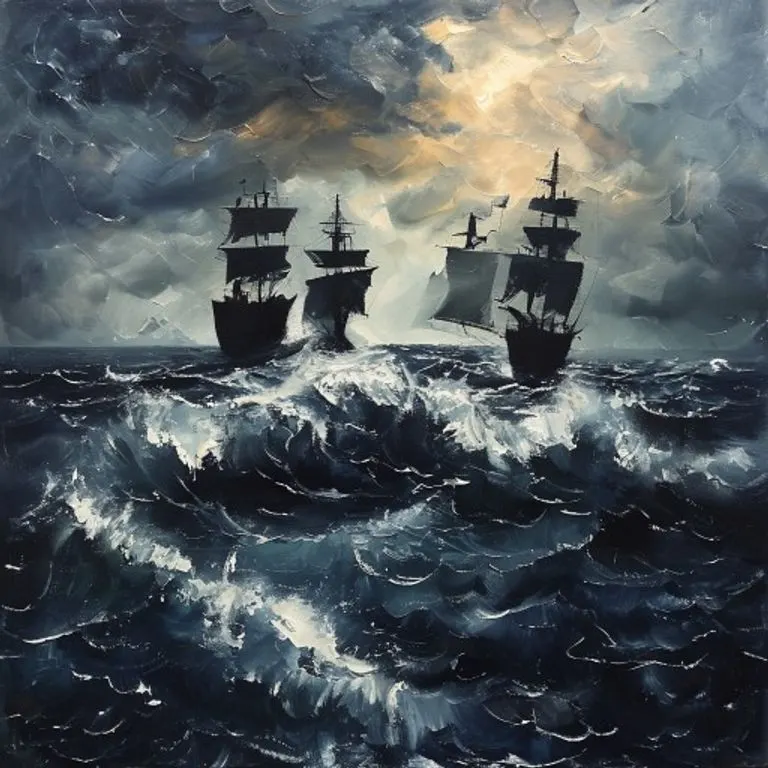
An oil painting captures the dramatic essence of a maritime collision, highlighting the legal complexities involved.
Forced Landing (Arribada Forzosa)
A forced landing, or "arribada forzosa," occurs when a ship is compelled to deviate from its planned route and seek refuge in an unscheduled port or place. This event, often triggered by unforeseen circumstances like severe weather, damage, or medical emergencies, has specific legal implications under the Spanish Commercial Code.
Section 1126. Forcible entry is necessary arrival of the ship to a port or place other than scale or terms provided for the trip.
Section 1127. Costs constitute a general average forced landing...
Section 1126 clearly defines a forced landing as the necessary arrival of a ship at a port or place not originally scheduled for the voyage. This deviation is not voluntary but compelled by circumstances beyond the captain's control, making it a critical aspect of maritime risk management. The necessity of the landing is key; it must be a measure taken to ensure the safety of the ship, its crew, or its cargo.
The most significant legal consequence of a legitimate forced landing is outlined in Section 1127: its costs constitute a general average. This means that the expenses incurred due to the forced landing—such as port charges, repairs necessary to continue the voyage, or costs of discharging and reloading cargo if required—are to be shared proportionally by all parties whose interests were saved by the action. This aligns with the fundamental principle of general average, where a sacrifice or extraordinary expense made for the common safety benefits all stakeholders.
For example, if a ship encounters a severe storm and must divert to a safe harbor to prevent sinking, the costs associated with that diversion would be distributed among the shipowner and all cargo owners. This provision encourages captains to make sound decisions for the overall safety of the maritime adventure, knowing that the financial burden will be equitably shared. The detailed procedures for general average, including declaration, challenge, and settlement, would then apply to these forced landing costs, ensuring a structured and fair resolution for all parties involved in the maritime shipping operations.
Conclusion
The Spanish Commercial Code, Book III, Title VI, provides a robust and detailed legal framework for managing the multifaceted risks inherent in maritime navigation. By meticulously defining various types of average, establishing clear procedures for general average declarations and challenges, and outlining responsibilities in cases of collision and forced landing, the Code ensures a structured approach to complex incidents at sea.
These regulations are vital for promoting fairness, mitigating financial uncertainties, and facilitating the smooth operation of international maritime trade. For shipowners, carriers, cargo owners, and insurers, a thorough understanding of these provisions is indispensable for effective risk management and legal compliance. The principles enshrined in this Code continue to influence modern maritime practices, underscoring the enduring importance of well-defined legal standards in the global shipping industry.
Frequently Asked Questions (FAQ)
Here are some common questions regarding maritime navigation risks under the Spanish Commercial Code:
- What is the primary difference between particular average and general average?
Particular average refers to damage or expense affecting only one specific interest (e.g., a ship or a part of the cargo), borne by its owner. General average, conversely, involves a sacrifice or extraordinary expense made intentionally and reasonably for the common safety of all interests in a maritime adventure, with costs shared proportionally among all saved parties.
- Who decides on general average measures and what is the process?
The captain of the ship or their substitute holds the sole authority to decide on general average measures. This decision must be recorded in the log book, detailing the event and justifications. Upon arrival at the first port, the facts must be formally confirmed before a minister of faith or a consul, depending on the location.
Fuente: Contenido híbrido asistido por IAs y supervisión editorial humana.


Comentarios